<?xml version="1.0" encoding="UTF-8"?>
<feed xmlns="http://www.w3.org/2005/Atom">
  <title type="text">Cleveland Historical</title>
  <updated>2026-04-17T14:04:10+00:00</updated>
  <generator uri="http://framework.zend.com" version="1.12.20">Zend_Feed_Writer</generator>
  <link rel="alternate" type="text/html" href="https://www.clevelandhistorical.org/"/>
  <link rel="self" type="application/atom+xml" href="https://www.clevelandhistorical.org/items/browse?output=rss2"/>
  <id>https://www.clevelandhistorical.org/</id>
  <author>
    <name>Cleveland Historical</name>
    <uri>https://www.clevelandhistorical.org</uri>
  </author>
  <link rel="hub" href="http://pubsubhubbub.appspot.com/"/>
  <entry>
    <title type="html"><![CDATA[Landmark Office Towers: The Professional and Corporate Heart of the Terminal Group]]></title>
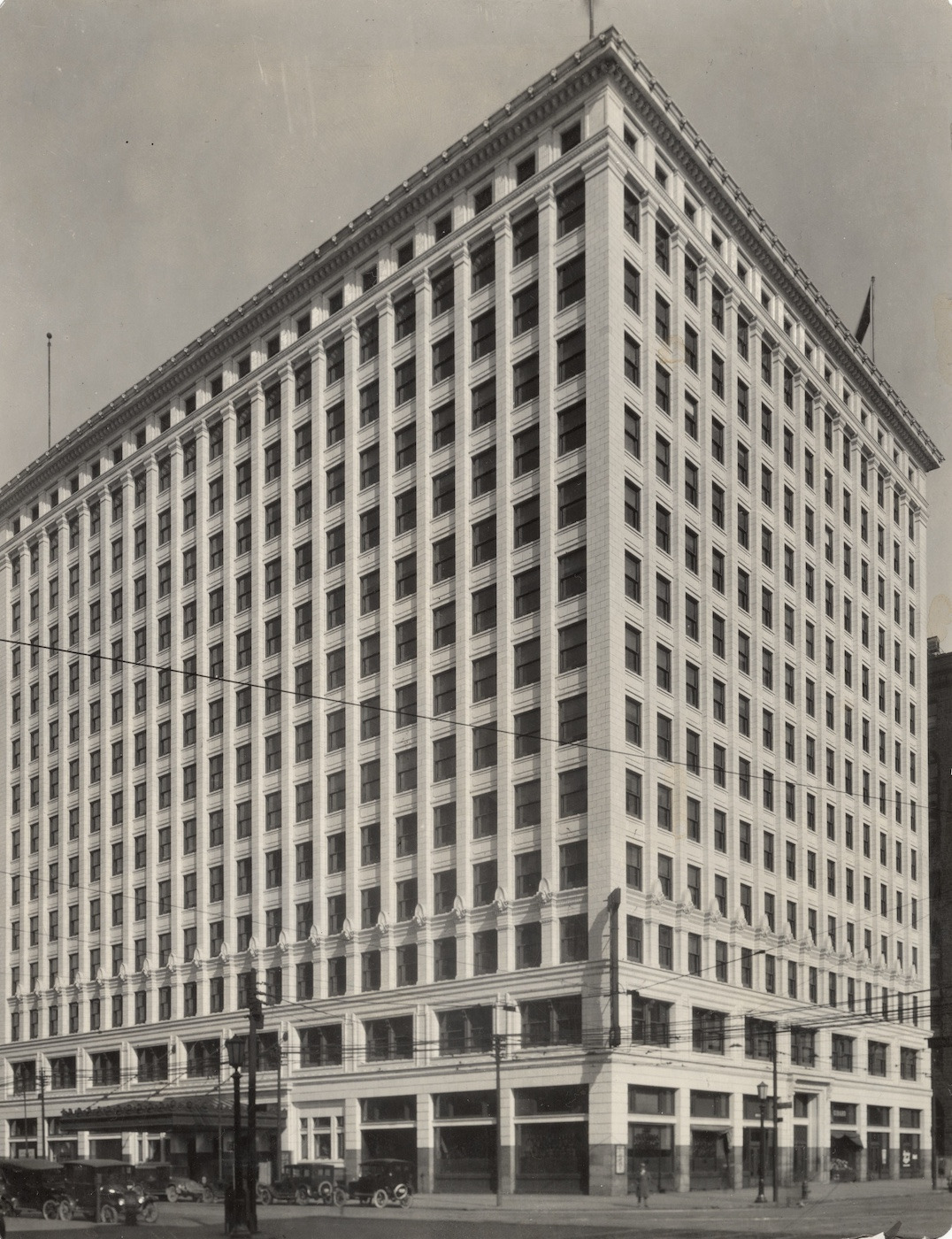
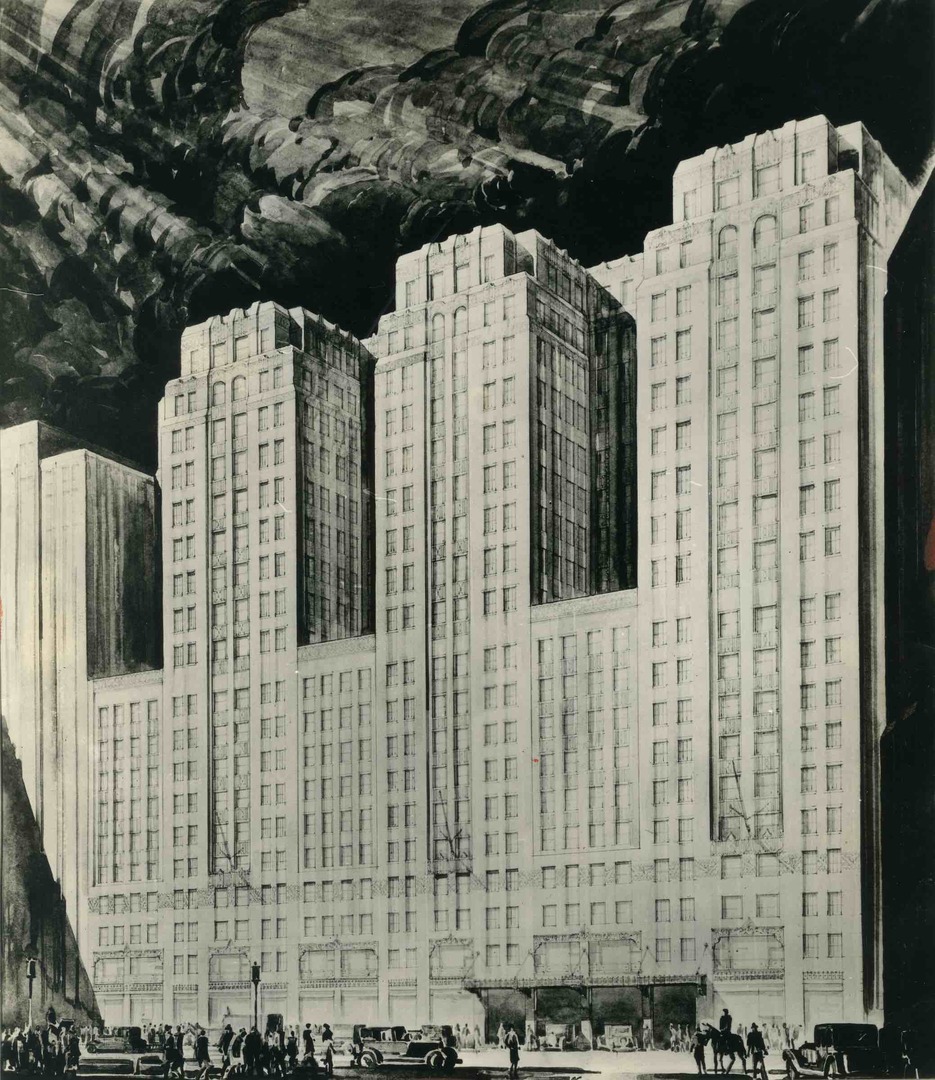
    <summary type="html"><![CDATA[<p><strong><em>Tower City Center, with its Public Square entrance, iconic tower, and flanking hotel and casino, has long overshadowed the office buildings to its rear despite their shared lineage as heirs of the Van Sweringen brothers’ vision. Yet the Landmark Office Towers complex on West Prospect Avenue deserves more attention for its splendid architectural details, novel interior features, and place in the history of some of Cleveland’s most significant corporate giants. </em></strong></p><img src="https://www.clevelandhistorical.org/files/fullsize/cf17bb9783a0e01e8bcbc10cdc20b577.jpg" alt="Original Rendering of Builders Exchange Building" /><br/><p>The three adjoining buildings that comprise Landmark Office Towers were originally conceived as part of Oris P. and Mantis J. Van Sweringen’s Cleveland Union Terminal complex, the “city within a city” the brothers launched in the 1920s. Designed by Graham, Anderson, Probst & White of Chicago and built between 1929 and 1930, the buildings occupied an entire city block bounded by Prospect Avenue, Huron Road, Ontario Street, and West 2nd Street, all of which were built as viaducts above the railroad tracks entering the Union Terminal. </p><p>In keeping with the idea of a city within a city, each building focused on a different sector: the Medical Arts Building was built for physicians’ and dentists’ offices; the Builders Exchange Building was devoted to businesses associated with the building trades; and the Midland Bank Building was dedicated to banking institutions and other business firms. The buildings included passageways connecting them with each other and with other components of the Terminal complex. A skybridge over Prospect, planned to link the Medical Arts Building with Higbee’s department store, was never added. </p><p>The three buildings were all built with structural steel frames clad with gray limestone on the lower four floors, cream face brick above, and terra-cotta trim near the tops. Detailed Art Deco motifs graced each facade, and the complex featured setbacks and light wells to break their bulk and provide ventilation. Inside, they featured travertine marble floors, fluted pilasters, plaster ceilings with ornamental friezes, and bronze elevator doors. The three-story lobby of the Midland Bank Building featured a wood-burning fireplace, a mezzanine, and pillars and panels carved from the trunks of seven giant oak trees. The trees were selected from an English estate and transported by steamship from Liverpool. The Builders Exchange Building included Guildhall, a tenth-floor restaurant inspired by a 15th-century London namesake, and a two-story demonstration house called the <a href="https://clevelandhistorical.org/admin/items/show/1028">Home in the Sky</a> on its two top levels.</p><p>The introduction of such an expansive block of choice office space soon after the onset of the Great Depression had a profound impact on downtown, precipitating a consolidation of business and professional activity around the Terminal and leaving older office buildings with hard-to-fill vacancies. Four major corporate headquarters relocated to the complex between 1930 and 1935. Two were local: Sherwin-Williams moved its offices from its Canal Road property into portions of the Midland Building and Builders Exchange Building, while Standard Oil Co. of Ohio (Sohio) left the East Ohio Gas Building on East 6th for the Midland Building. The Midland Building also attracted the Erie Railroad headquarters away from New York City in 1931 and Republic Steel from Youngstown in 1935. The arrival of the latter led the Medical Arts Building to be renamed the Republic Building. </p><p>Yet the Depression also forced the complex to grapple with challenges. In 1932, Midland Bank went bankrupt and merged into Cleveland Trust, closing its offices in its namesake building. Three years later, the Van Sweringen Company went bankrupt. Thereafter, ownership of the towers complex was administered by the Prospect Terminals Building Co., a subsidiary of Cleveland Terminal Building Co. In 1940, the Cleveland Builders Exchange left for a new headquarters on Euclid Avenue, and Sherwin-Williams expanded to the floors that had housed the Exchange's Home in the Sky. At that time, the building was named the Guildhall Building.</p><p>In 1950, Cleveland Terminal Building Co. sold the entirety of the Union Terminal group except the rail station in 1950 to the 66 Trust of Philadelphia. That same year, the four main tenants of the towers complex — Republic Steel, Erie Railroad, Sohio, and Sherwin-Williams — formed RESS Realty (a portmanteau of their names) to coordinate leasing of office space in the three conjoined towers. For the 35 years that followed, the complex harbored a workforce of around 5,000 people. </p><p>In 1986, ten years after the Erie-Lackawanna Railroad (formerly Erie Railroad) closed its Cleveland headquarters following its merger into Philadelphia-based Conrail, Sohio completed its move from the Midland Building to its new 45-story headquarters on Public Square. Following the departures of these firms and Republic’s recent merger into LTV Steel, RESS Realty was administered by only LTV and Sherwin-Williams. In the year preceding Sohio’s exit, RESS Realty renovated and rebranded the LTV-Guildhall-Midland Building complex as Landmark Office Towers. </p><p>During the renovations, Sherwin-Williams bought the complex, bringing its ownership back to Cleveland. Changes included a central lobby for the elevator banks serving all three buildings, along with the revitalization of the Midland Building’s lobby, which Sohio had modernized into offices with dropped ceilings in 1970, as the Van Sweringen Arcade. The bank’s vault became Haymarket Restaurant, later Piperade, and then Hyde Park Chophouse until the space closed in 2011. </p><p>The renovation and promotion succeeded in turning around the towers at a critical time. After Sohio moved out, the complex’s occupancy dropped from 100% to 62%, but upon completion of the renovations, it bounced back to 90%. Landmark Office Towers had a nearly four-decade run until its owner, Sherwin-Williams, sold the complex to Detroit-based Bedrock in 2023 ahead of the paint and coatings company’s move to its new 36-story headquarters tower on Public Square. Today, the future of the complex seems tied to Bedrock’s Riverfront Cleveland project, but its precise use is uncertain. Office demand in downtown districts has not recovered from the pandemic collapse of 2020, and conversion of such a massive structure to residential use is costly. But the towers — with their Art Deco flourishes, contribution to a big-city atmosphere, and central location in an evolving downtown — deserve a new, bold vision.</p><p><em><strong><a href="https://www.clevelandhistorical.org/items/show/1084">For more (including 21 images) view the original article</a></strong></em></p>]]></summary>
    <published>2026-04-03T13:57:15+00:00</published>
    <updated>2026-04-04T22:02:25+00:00</updated>
    <link rel="alternate" type="text/html" href="https://www.clevelandhistorical.org/items/show/1084"/>
    <id>https://www.clevelandhistorical.org/items/show/1084</id>
    <author>
      <name>J. Mark Souther</name>
    </author>
  </entry>
  <entry>
    <title type="html"><![CDATA[I-X Center: From Factory to Exposition Center]]></title>
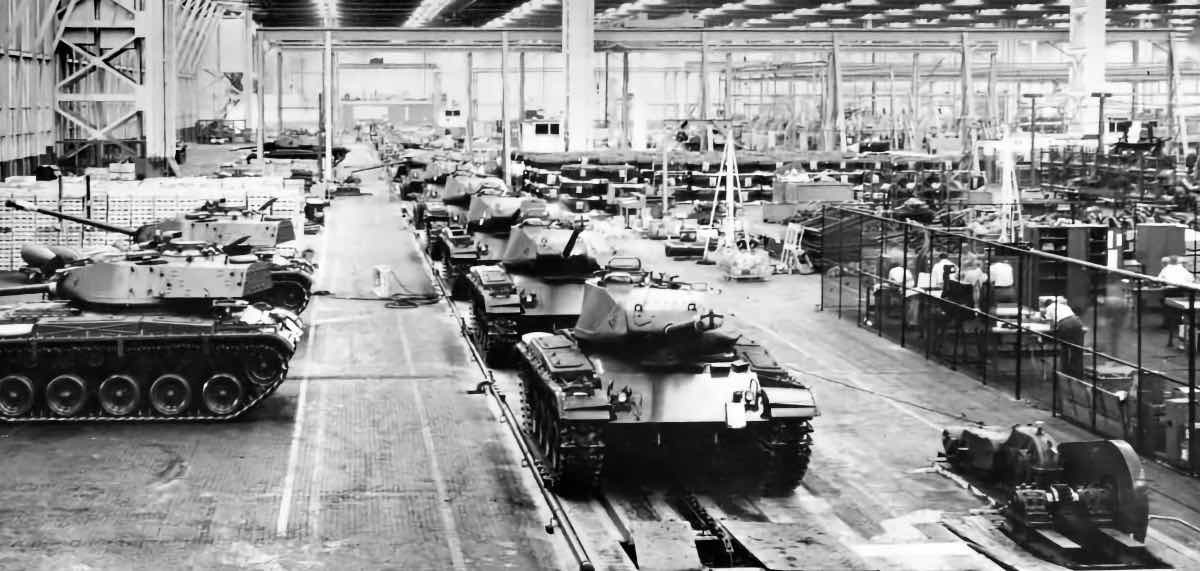
    <summary type="html"><![CDATA[<p><strong><em>The International Exposition Center, originally built as the Cleveland Bomber Plant, has seen an impressive variety of uses over its years of operation. From bomber planes and tanks to the various trade shows and events, the I-X Center has been used for countless different productions and conventions.</em></strong></p><img src="https://www.clevelandhistorical.org/files/fullsize/d918f614ed2aac926ea0fd41c3c6304a.jpg" alt="M41 Walker Bulldog Tanks" /><br/><p>The International Exposition Center, originally known as the Cleveland Bomber Plant, was built in 1942 with the purpose of constructing major sections of B-29 bombers for the United States during the Second World War. It was constructed and owned by the U.S. Department of Defense and was operated by Fisher Body, a subsidiary of General Motors. Following the conclusion of World War II, the Cleveland Bomber Plant was used briefly as an exhibition hall and sales center, a foreshadowing of what was to come many years later.</p><p>The workspace at the Cleveland Bomber Plant during World War II was diverse. African American men and women worked alongside white workers for attractive wages for the time. The demand for workers in the factory was so great that employees required approval from the Department of Defense to change jobs. Aside from the fabrication of B-29 bomber nose and tail sections, Fisher Body also received a contract to build and test top-secret experimental XP-75 fighter planes. The operations were so secretive that those working at the plant did not even know the specifications of the planes themselves.</p><p>After the end of World War II, the Cleveland Bomber Plant was leased to National Terminals and used as a soybean storage facility. The plant was used in this way until the beginning of the Korean War. U.S. involvement in the Korean War saw the Cleveland Bomber Plant become the Cadillac Tank Plant (or Cleveland Tank Plant). During the time of the Cadillac Tank Plant, the plant had expanded to include a photo department, a labor relations office, a full-time lawyer's office, and even a hospital with nurses and a staff doctor. This expansion, coupled with the thousands of workers at the facility, made the plant feel more like a small town in its own right than just a place of work.</p><p>The Cadillac Tank Plant produced tanks, artillery pieces, and other military vehicles with varying degrees of success. Following two years of production, the U.S. Army rejected all tanks made at the plant because of a faulty gun mechanism. In 1953, the Walker Bulldog, a light tank, was successfully put into service in Korea.</p><p>Between 1964 and 1966, Chrysler held the manufacturing contract at the plant while General Motors held the engineering contract. The relationship between these two companies was reputed to be poor. The plant was divided between these two companies, and a wall was built to protect trade secrets from one another, showcasing the lack of cooperation between the two. Chrysler would eventually lose the manufacturing bid to the Allison division of General Motors, leading to a smoother production process once again. Production continued until 1972. With United States involvement in the Vietnam War coming to an end, the U.S. government decided not to continue with the program upon the completion of the last General Motors contract.</p><p>After the Department of Defense closed the Cleveland Tank Plant, it made the site available for purchase. General Motors and the cities of Brook Park and Cleveland all showed some interest in purchasing the tank plant, but ultimately, none of them bought it.</p><p>In 1977 the plant was purchased by The Park Corporation of Charleston, West Virginia, with the intention of transforming the it into an international trade mart. Years after its purchase, in 1985 the facility reopened as the International Exposition and Trade Center, or I-X Center, and was reputedly the largest single-building exposition facility in the world. The I-X Center hosted a large variety of events such as conferences, car, motorcycle, boat, and home and garden shows, trade shows, and later the I-X indoor amusement park.</p><p>The I-X Center had created strong competition for the Cleveland Convention Center. After it opened, the I-X Center drew away both the auto and boat shows that were previously held at the downtown convention center.  Local unions tried to create new contracts that were aimed at helping the Cleveland Convention Center to keep or attract new trade shows, as the available work at the Cleveland center continued to decline. There was also a "gentlemen's agreement" between Ray Park, owner of the I-X Center, and the City of Cleveland that the I-X Center would not solicit shows that were traditionally run at the Cleveland Convention Center. Despite this agreement, however, the I-X Center offered the space and time desired by shows such as the Auto Show, and the I-X Center was picked over the Cleveland Center.</p><p>The Cleveland Convention Center went under renovations and attempted to showcase and market these renovations to remain competitive with the I-X Center and other cities. These renovations proved not to be enough as the Cleveland Convention Center would continue to operate at a loss after its most profitable shows went to the I-X Center.</p><p>The addition of 185,000 square feet of exhibit space in 2008 puts the I-X Center at a total of 2.2 million square feet, and it remains one of the largest trade show and exhibition centers in the world as of 2026. The I-X Center was closed during the COVID pandemic and was purchased and reopened by the Industrial Realty Group in 2021. Events continued until March 2026, with the Industrial Realty Group seemingly uninterested in continuing to use the I-X Center for event space.</p><p>The I-X Center remains a historic piece of Cleveland's industrial and commercial legacy. From the manufacturing of important military hardware to one of the largest exposition centers in the world, its many different uses mirror the shifting phases of Cleveland's economy.</p><p><em><strong><a href="https://www.clevelandhistorical.org/items/show/1081">For more (including 7 images) view the original article</a></strong></em></p>]]></summary>
    <published>2026-03-06T15:40:14+00:00</published>
    <updated>2026-04-15T20:36:51+00:00</updated>
    <link rel="alternate" type="text/html" href="https://www.clevelandhistorical.org/items/show/1081"/>
    <id>https://www.clevelandhistorical.org/items/show/1081</id>
    <author>
      <name>Jaret Glueck</name>
    </author>
  </entry>
  <entry>
    <title type="html"><![CDATA[Saint Josaphat of Parma: From Mission to Parish to Cathedral]]></title>
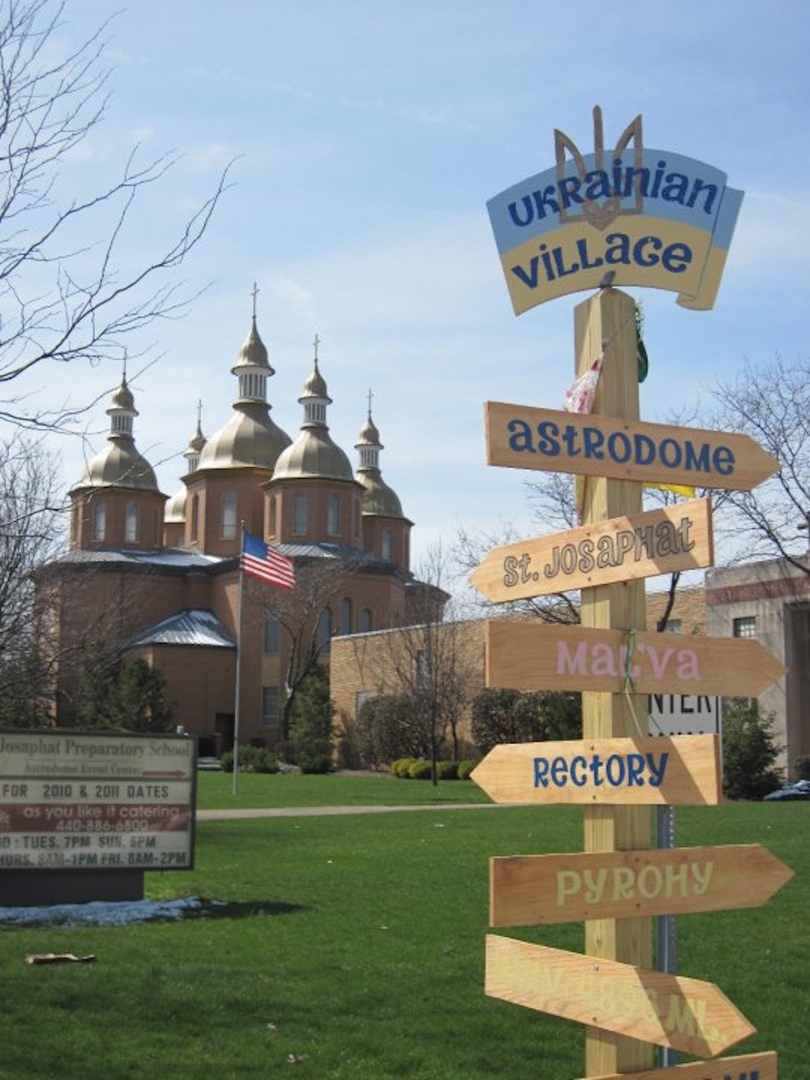
    <summary type="html"><![CDATA[<p><strong><em>Like the Ukrainian population itself in Parma, Saint Josaphat Ukrainian Catholic Church had an inauspicious start—a simple brick and stone schoolhouse built in 1949 on ten acres of land on State Road.  However, less than forty years later, as the Ukrainian population in Parma was growing into the largest in the State of Ohio, Saint Josaphat became a Cathedral church and  the seat of  a new Ukrainian Catholic eparchy whose territory includes Ohio, part of Pennsylvania and most of the South.</em></strong></p><img src="https://www.clevelandhistorical.org/files/fullsize/dd208222bed267ab663c6c38be39d65e.jpg" alt="Saint Josaphat Cathedral in the Shadow of Parma Ukrainian Village Signage" /><br/><p>The first generation of Catholic Ukrainians to come to Cleveland in the late nineteenth and early twentieth centuries were Ruthenians, who had immigrated from a mountainous area within Galicia known as Ruthenia. Their lands were then located within the Austro-Hungarian Empire. Today, they are part of Ukraine and Poland. Religiously, these Ruthenians were Byzantine or Greek Catholics, or sometimes called Uniates. They were spiritual descendants of Eastern Orthodox Ruthenians and other Eastern European groups who, through the Union of Brest in 1596, had sworn allegiance to the Roman Catholic pope, while retaining a right to practice most of their historic Eastern Orthodox customs, rituals, and liturgy.</p><p>Settling in the Tremont neighborhood, the immigrant Ruthenians, in 1910, built a church of their own that still stands today on West 7th Street, near College Avenue. It was first called Saints Peter and Paul Ruthenian Catholic Church, but was renamed <a href="https://clevelandhistorical.org/items/show/738">Saints Peter and Paul Ukrainian Catholic Church</a> at the conclusion of World War I when the first modern Ukrainian state was established.</p><p>For most of the first half of the twentieth century, the children of the parishioners at Saints Peter and Paul Church attended school either in the basement of their church in Tremont or at other places in Cleveland. In 1947, Pastor Dmytro Gresko and his parishioners decided that they would build an elementary school for the parish children on land located in the suburb of Parma. Their decision was likely influenced by the number of parishioners who, since the end of World War II, had been moving out of Tremont and into that fast growing suburb.</p><p>The land selected for the new elementary school was a 10-acre parcel that lay on the west side of State Road between Kenmore Avenue and Liggett Drive. It was located just two blocks north of Saint Francis de Sales Catholic Church, and almost directly across the street from the Saint Stanislaus Novitiate, later renamed the Jesuit Retreat House. In the 1920s, the Order of the Polish Sisters of Saint Joseph had planned to construct a convent and school on this land. However, the Sisters later decided to instead construct those buildings—the latter of which was later known for many years as Marymount High School—on Granger Road in Garfield Heights. The Sisters then sold the land in Parma in 1929. </p><p>The land's new owners agreed, in October 1947, to sell it to Saints Peter and Paul Ukrainian Catholic Church for $17,500. In April 1949, construction began on the new two-story, brick and stone Saints Peter and Paul school building. Completed that fall, it had eight classrooms for students on its north end and a large assembly hall on its south end that could hold 500 persons and also serve as a chapel. On November 6, 1949, a dedication ceremony was held at the new school, led by Ukrainian Catholic Archbishop Constantine Bohachevsky of the Philadelphia Archeparchy, with assistance from Cleveland Bishop Edward F. Hoban and other Catholic church officials. At the ceremony, it was noted that this was the first Ukrainian Catholic grade school built in the Cleveland area. </p><p>Two years after dedicating the new school, Archbishop Bohachevsky returned to Parma on May 12, 1951 to bless the chapel in the school building which was named Saint Josaphat Chapel, after Josaphat Kuntsavych, a Ukrainian priest who had been murdered in 1623 because of his efforts, consistent with the tenets of the Union of Brest, to bring together Eastern Orthodox Christians and Roman Catholics living in Galicia, which in that period was part of the Polish-Lithuanian Commonwealth. </p><p>Classes began at Saints Peter and Paul grade school on November 15, 1949, with a total of 135 students attending only grades one through three in that first year. Because many of those students still lived in Tremont, the parish also purchased a bus to transport children to and from the school in Parma. One of those bus drivers was Father Myroslav Lubachivsky, then an assistant pastor at Saints Peter and Paul. Some thirty-five years later, in 1985, he would be appointed a Cardinal of the Ukrainian Catholic Church by Pope John Paul II. </p><p>During the period 1950-1960, the number of people of Ukrainian, and other Eastern and South European ethnicities, moving into Parma more than tripled, as that city became one of the fastest growing suburbs in America. In order to address the increases in the Ukrainian Catholic population, Saints Peter and Paul added several new buildings to the Parma campus, including another classroom building, a rectory and a convent, and expanded the grades taught at the school to include from kindergarten to eighth grade. </p><p>In August 1959, recognizing the significant increase in the Ukrainian Catholics living in Parma, Archbishop Bohachevsky announced the creation of a new Ukrainian Catholic parish in Parma, to be sited on the grounds of Saints Peter and Paul grade school. The new parish was named—and the grade school renamed—like the chapel, Saint Josaphat. Father Andrew Ulicky, an assistant pastor at Saints Peter and Paul, was appointed the first pastor of this new Ukrainian Catholic parish. </p><p>Shortly after his appointment as pastor, Father Ulicky initiated plans to build a high school on the State Road campus. Construction of the building began in 1961, largely funded through the efforts of parishioners who not only gave money to the project, but also volunteered to do much of the skilled construction work. The new circular-shaped high school building was designed by architect and engineer Michael Stefanyk, who volunteered his services to the parish. </p><p>The building featured a wooden domed roof with a 141-foot diameter. However, because of mounting costs and limitations on the amount of time that could be spent on construction by parish volunteers, construction of the building lagged for years, taking many more years to complete than the two years initially anticipated. In the interim, while it sat unfinished, the building became a favorite haunt of Parma teenagers, who visited it often at night, conducting what might be called an early form of urban (or suburban) exploration. </p><p>The proposed high school building was finally completed in 1969 and blessed by Metropolitan Archbishop Ambrose Senshyn on April 20 of that year. By that time, however, the plan to use the building as a high school had been abandoned, largely due to the establishment of Saint Andrew Ukrainian Catholic parish on the south end of Parma in 1965. The creation of the new parish prompted the departure of about 500 families from Saint Josaphat. </p><p>When the circular, domed building was blessed, it was given the name Saint Josaphat Astrodome Hall—commonly known as the "Astrodome" in reference to Houston's recently completed domed stadium. Rather than serving students as their new high school, the building was repurposed as an assembly hall for the use of the Saint Josaphat parish. Since its completion, it has been the venue for many parish events, as well as serving as a venue for the events of other organizations, such as ethnic festivals, and for individual events, including weddings. </p><p>After the completion of the Astrodome, Father Ulicky and the parish's second pastor, Father Yaroslav Sirko, who succeeded Father Ulicky in 1971, turned their attention to building a church on the State Road campus. The need to do so became pressing when, on April 11, 1973, a horrific fire at Saint Josaphat grade school destroyed the chapel within the school building. As a temporary measure, masses were thereafter held in the Astrodome. Father Sirko, who was the pastor at the time of the 1973 fire, wanted to immediately construct a new church, but was unable to do so due to the state of parish finances at the time. </p><p>As a result, the challenge to build the new church fell to the parish's third pastor, Father Michael Fedorowich, who came to Saint Josaphat in 1979. By 1981, the parish finances had sufficiently improved to enable Father Fedorowich to begin construction. By the summer of 1983, when construction was almost completed, word was received by the parish that the new Saint Josaphat church was to become a Ukrainian Catholic cathedral and seat of a new eparchy—the equivalent of a Roman Catholic diocese—for the Ukrainian Catholic Church in the United States. As a result of this development, additional construction was required in order to render the building's interior suitable as a cathedral. The following year, Father Robert Moskal was appointed the first bishop of the new Ukrainian Catholic Eparchy of Parma, Ohio.</p><p>When the 1990 federal census was taken—the first one following the completion of Saint Josaphat Cathedral and creation of the new Parma Ukrainian Catholic Eparchy, the results of the community questionnaires for Parma showed that the city's Ukrainian population, which in 1950, had been one of the smallest for residents of East European ancestry, had now become one of the largest, behind only the Polish and Slovak populations. In subsequent years, the Parma Ukrainian community continued to grow until it became, according to an article appearing in the Cleveland Plain Dealer on March 24, 2022, the largest in the State of Ohio. </p><p>Along the way of their journey as one of the most important Ukrainian institutions in Parma, Saint Josaphat and its parishioners have experienced their share of joys and sorrows at their now historic State Road campus. In 2008, Saint Josaphat Ukrainian Catholic grade school,which had served children of the parish for nearly 60 years, closed its doors for good. However, in what must have been somewhat consoling to the parish, several years later the school building became home to a new K-8 public community school called the Global Village Academy, which offers language and cultural programs to students in every grade. </p><p>On an even more positive note, in 2008 the Parma City Council passed a resolution recognizing the many contributions that Ukrainians at Saint Josaphat and other institutions in the City had made, and honoring the Ukrainian community with the establishment of <a href="https://clevelandhistorical.org/items/show/863">Ukrainian Village</a>, a section of State Road beginning at Tuxedo Avenue on its north end and extending south all the way to Grantwood Drive, with signs alerting drivers of the existence of the Village. </p><p>Today, visitors to Parma, who drive to the suburb on State Road will, as they cross Brookpark Road, immediately take notice of the colorful signage which announces that they are entering Ukrainian Village. Within moments thereafter, they will see the five majestic onion domes of the beautiful Saint Josaphat Cathedral. The signs and the domes inform visitors not only of the historical importance of Saint Josaphat to Parma's Ukrainian community, but also of its importance to the City of Parma itself.</p><p><em><strong><a href="https://www.clevelandhistorical.org/items/show/1078">For more (including 16 images) view the original article</a></strong></em></p>]]></summary>
    <published>2026-01-08T16:48:20+00:00</published>
    <updated>2026-04-15T14:57:24+00:00</updated>
    <link rel="alternate" type="text/html" href="https://www.clevelandhistorical.org/items/show/1078"/>
    <id>https://www.clevelandhistorical.org/items/show/1078</id>
    <author>
      <name>Jim Dubelko</name>
    </author>
  </entry>
  <entry>
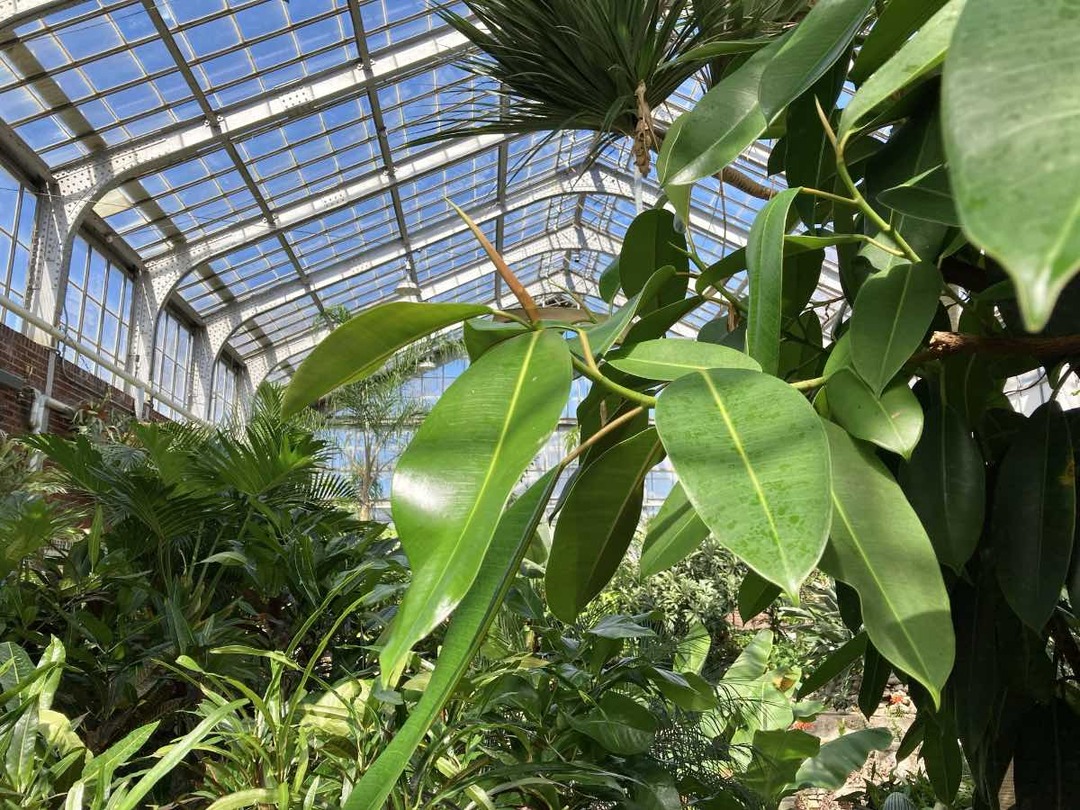
    <title type="html"><![CDATA[Rockefeller Park Greenhouse: Municipal Nursery and Botanical Garden]]></title>
    <summary type="html"><![CDATA[<p><strong><em>Tucked away on a hilltop above the Cultural Gardens is an unassuming facility that for more than a century has played a mostly unseen role in supplying the Forest City’s parks, boulevards, and public properties with flowers, shrubs, and trees, while also cultivating a distinctive collection of tropical foliage and fruit-bearing trees.</em></strong></p><img src="https://www.clevelandhistorical.org/files/fullsize/ff65e75684b088775c7c081ec99ba269.jpg" alt="Tropical Showhouse" /><br/><p>The Rockefeller Park Greenhouse has its origin in greenhouses given to the city by the estate of William J. Gordon, whose country seat became Gordon Park in 1894. Five years after John D. Rockefeller deeded land to connect Gordon Park with Wade Park in 1897, the municipal government planned a new “city greenhouses” complex, which opened in 1905. Sometimes erroneously referred to as the Gordon Park Greenhouse in its early years, the complex was actually in Rockefeller Park. </p><p>The primary purpose of the city greenhouses was to supply trees and shrubs for Cleveland’s parks, boulevards, and public properties. The greenhouses also donated flowers to hospital wards. However, the idea of a botanical showcase for the city also took root. In 1913, the city completed a large new greenhouse to display palms, ferns, and orchids to the public, including the donated exotic plant collection of William E. Telling. This greenhouse also provided a place to keep the goldfish from the Public Square pond during the winter. </p><p>Despite its pre–World War I origins, the Rockefeller Park Greenhouse as we know it is largely a product of the New Deal. Between 1937 and 1939, the Works Progress Administration (WPA) rebuilt the city greenhouses with a substantial new Palm House (now called the Tropical Showhouse) surrounded by six other greenhouses that raised the facility’s area under glass sixfold to 35,000 square feet. A center walk divided the Palm House into two lush sunken gardens lined with tufa rock salvaged from the Great Lakes Exposition. One of these gardens featured a waterfall and the other a statue. Looming overhead were six 30-foot-tall royal palms taken from the Florida exhibit at the Great Lakes Exposition, as well as other tropical trees and plants. </p><p>After World War II, City Greenhouse, as it was then known, unveiled periodic improvements. In 1946, the greenhouse’s new cacti exhibit opened, its specimens backed by a painted desert scene in the fashion of a diorama. In addition to continuing to serve as a prominent destination for garden clubs and other groups, City Greenhouse also furnished tropical plants for special events, notably a New Orleans French Quarter–themed display for the 1956 Cleveland Home and Flower Show in Public Auditorium. </p><p>In 1962, the Leonard C. Hanna Fund gave $300,000 to improve and expand City Greenhouse. The gift funded a new entrance building and a Japanese Garden, completed in 1964, at which time the facility began to be known as Rockefeller Park Greenhouse. Unfortunately, in the following decade the facility began to suffer a dwindling city budget that accompanied Cleveland’s steepening population decline. By 1980, the city briefly contemplated closing the greenhouse before deciding against it. Then, in 1991, the Friends of Greenhouse, a nonprofit, formed to raise funds to place the facility on a firmer footing and use it to host special events. Later additions included the Betty Ott Talking Garden with its statue of Helen Keller and the Willott Iris Garden, in which hundreds of varieties of iris bloom each spring and summer.</p><p>Today the Rockefeller Park Greenhouse remains, as it has for more than a century, a place of welcome respite from the winter cold and arguably one of the city’s best free attractions in Cleveland.</p><p><em><strong><a href="https://www.clevelandhistorical.org/items/show/1076">For more (including 14 images) view the original article</a></strong></em></p>]]></summary>
    <published>2026-01-02T17:52:59+00:00</published>
    <updated>2026-04-04T22:15:08+00:00</updated>
    <link rel="alternate" type="text/html" href="https://www.clevelandhistorical.org/items/show/1076"/>
    <id>https://www.clevelandhistorical.org/items/show/1076</id>
    <author>
      <name>J. Mark Souther</name>
    </author>
  </entry>
  <entry>
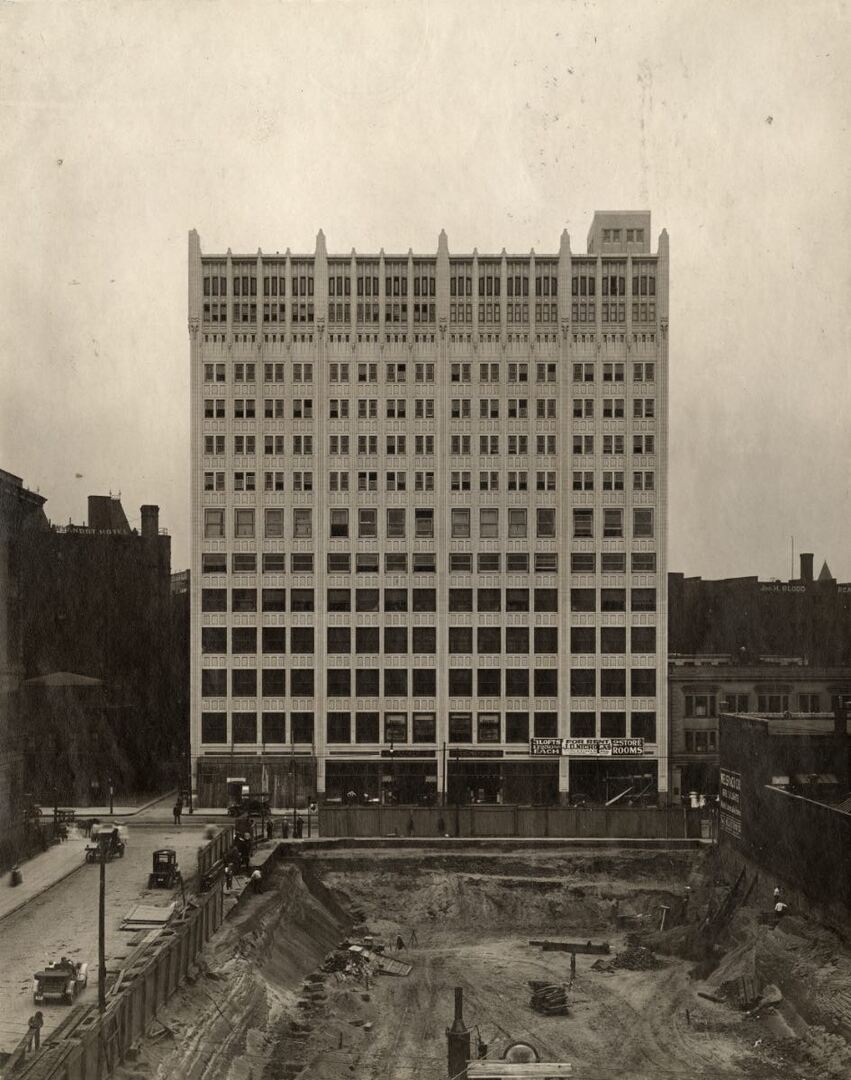
    <title type="html"><![CDATA[Cleveland Athletic Club: The Star-Studded History Behind the Athlon ]]></title>
    <summary type="html"><![CDATA[<p><strong><em>The Cleveland Athletic Club was an epicenter of sports culture in Cleveland  for almost a century. Athletes from home and abroad used the CAC's state-of-the-art training facilities and amenities, including a large gymnasium, an indoor track, and an Olympic-sized swimming pool, some of them making sports history in the process.</em></strong></p><img src="https://www.clevelandhistorical.org/files/fullsize/3045ffb5f072f18bc25d854d4ddf7bba.jpg" alt="CAC under Construction " /><br/><p>For much of the twentieth century, sports and physical fitness were interwoven with Cleveland’s civic life. One place where this sporting culture took shape was the Cleveland Athletic Club (CAC) Building on Euclid Avenue, designed by architect J. Milton Dyer, who also held other notable local commissions, including for the design of Cleveland City Hall. The architectural contract awarded to Dyer totaled $150,000, marking the building as a significant investment for its time. Operating from 1908 until its closure in 2007, the Cleveland Athletic Club served generations of members and offered state-of-the-art athletic facilities that reflected the growing interest in organized recreation and physical training in the early twentieth century. </p><p>The CAC’s origins date to the night of August 10, 1907, when a group of founding members held their first preliminary meeting in the rooms of the Cleveland Auto Club. At that meeting, they elected a temporary president, secretary, and treasurer, and began organizing what would become one of Cleveland’s leading private athletic institutions. Most of these early members were affluent businessmen and professionals who contributed their own funds to establish the club and recruit additional members. Membership grew steadily during the club’s early years, even as members debated the final location of the clubhouse. </p><p>Formal elections were held in 1908. W. P. Murray was once again elected president. Also elected that evening were A. J. Huston as vice president, George A. Schneider as secretary, and A. H. Bedell as treasurer. After two more years of discussion, members decided on a site on Euclid Avenue in 1910. The finished clubhouse occupied the upper ten floors of the 15-story Cleveland Athletic Club Building, which opened in November 1911, giving the CAC a permanent home. </p><p>From its earliest years, the Cleveland Athletic Club distinguished itself through its facilities, which included multiple gymnasiums, boxing rings, handball courts, and a large indoor swimming pool, as well as dining rooms, meeting spaces, and social areas. These amenities made the club both a center for athletic training and a favored spot for Cleveland’s business and professional community to gather. </p><p>The clubhouse attracted many prominent athletes to its facilities for training exercises. Boxing legend Joe Louis trained for several days at the CAC during a visit to Cleveland in 1936. Swimming exhibitions and competitions were also held in the club’s twelfth-floor natatorium, attracting many skilled swimmers. The most illustrious was Johnny Weissmuller, who set the world record for 150-yard backstroke in the club pool in 1922 before going on to win five gold medals in the next two summer Olympics and, later, starring in the <i>Tarzan</i> films. </p><p>Track meets hosted by the club marked another contribution to the city’s sporting culture and gave young athletes a place to develop their skill during the winter months. Among them was Jesse Owens, who participated in meets there during his school years. At the time, Owens was already gaining recognition locally for his remarkable speed, shattering several records—some of them his own—on the club’s track. </p><p>The Cleveland Athletic Club remained a strong institution for nearly a century, serving as one of a number of prestigious anchors on the city’s most celebrated street. Although the CAC closed in 2007, the building continues to offer a reminder of the era when large cities’ athletic clubs were prominent features of urban civic life. When it was converted into apartments in 2019, the CAC Building got new name—The Athlon—that commemorates its history as a place that connected the city to regional and national athletic networks and gave Clevelanders an opportunity to see some of the great athletes of their time.</p><p><em><strong><a href="https://www.clevelandhistorical.org/items/show/1075">For more (including 8 images) view the original article</a></strong></em></p>]]></summary>
    <published>2025-12-01T17:13:53+00:00</published>
    <updated>2026-04-14T16:29:12+00:00</updated>
    <link rel="alternate" type="text/html" href="https://www.clevelandhistorical.org/items/show/1075"/>
    <id>https://www.clevelandhistorical.org/items/show/1075</id>
    <author>
      <name>Clark Helm</name>
    </author>
  </entry>
  <entry>
    <title type="html"><![CDATA[Lake Shore Electric Railway: The Interurban That Connected Northern Ohio’s Communities, Commerce, and Imagination ]]></title>
    <summary type="html"><![CDATA[<img src="https://www.clevelandhistorical.org/files/fullsize/5471fdaa8743e0064365cc759dfa425d.jpg" alt="Stop 16 in Bay Village" /><br/><p>In the early decades of the twentieth century, the Lake Shore Electric Railway (LSE) was more than a transportation system — it was a lifeline binding the farms, factories, lakefront resorts, and rapidly growing cities of northern Ohio. With its bright orange interurban cars racing along the Lake Erie shoreline, the LSE offered an unprecedented blend of speed, comfort, and electric modernity. Although the line is gone today, its legacy remains stamped into the region it once transformed.</p><p>To understand the rise, evolution, and eventual demise of the Lake Shore Electric Railway, one must first picture the majesty of the Midwestern interurban at its height. Imagine yourself in 1907 on a street corner in Fremont, watching long, sleek, all-metal electric cars glide past — faster than any horse could run, faster even than many steam trains dared to travel between small towns. Inside each car, the glowing wood trim, leather seats, and faint scent of oiled steel created a warm refuge for commuters, vacationers, workers, families, and young couples bound toward new horizons.</p><p>The LSE’s trackage mirrored the diversity of northern Ohio itself. In busy towns, cars rang sharply against railheads set into the streets, past merchants leaning in their doorways. Outside city limits, the cars leapt forward across private rights-of-way that carved through farmland, orchards, forests, and shoreline. Sidings, spurs, and expertly placed switches formed an intricate choreography that kept the LSE’s operations precise and reliable — the project was an engineering triumph of the interurban era.</p><p>The term “interurban” described electric railways that operated between cities, bridging the gap between slow, urban streetcars and heavyweight steam railroads. By the 1890s, electric traction was replacing horse-drawn systems nationwide, and Ohio quickly emerged as the epicenter of the new technology.</p><p>The foundations of the future LSE were laid by several early lines across northern Ohio. In 1890, the East Lorain Street Railway was organized and in 1893, the Sandusky, Milan & Huron Railway introduced true interurban practice, with heavier cars running at higher speeds on separate rights-of-way. In the mid-1890s, the Everett-Moore Syndicate (a powerful group of investors led by Henry Everett and Edward Moore) rapidly expanded electric railway holdings across northeastern Ohio. </p><p>The Lorain & Cleveland (L&C), one of the precursors of the LSE, was among the first high-speed interurbans in the nation, capable of maintaining speeds that exceeded 50 miles per hour on a privately built line that hugged the shoreline. In 1897, the company constructed Avon Beach Park Station across from Beach Park, a 65-acre amusement complex complete with a dance hall, baseball fields, bowling alley, cottages, and sandy beaches. The electric generating plant on-site powered both the park and the railway, and its tall chimney was visible for miles.</p><p>The true Lake Shore Electric Railway emerged in 1901, when the Everett-Moore Syndicate consolidated the Lorain & Cleveland, the Sandusky, Norwalk & Southern, and the Sandusky & Interurban Electric. The LSE connected Cleveland, Toledo, Detroit, and dozens of smaller communities with comfortable, high-speed service. The interurban era was cresting nationwide, and Ohio — then the state with the most electric railway mileage in the country — stood at its forefront.</p><p>The LSE carried both passengers and freight. The Cleveland terminus of the LSE line was located on Public Square, while the city’s freight operations centered around depots near East 9th Street, served by express companies like Wells Fargo. Freight became especially crucial during the Great Depression, when bulk goods and parcel shipments helped sustain the struggling interurban.</p><p>The LSE operated a diverse fleet of electric cars, both powered and unpowered, built by renowned manufacturers such as Jewett, J.G. Brill, Niles, Birney, and the St. Louis Car Company. Early cars were wooden, with stained glass, clerestory roofs, and elaborate trim, but by the 1910s, steel cars offered increased safety and durability.</p><p>Color became a cultural hallmark of the LSE. Early newspapers described the fleet as “yellow” or “regulation yellow,” though this was likely cadmium orange — often photographed as pale due to orthochromatic film. By the 1920s, “Traction Orange” had become the standard. These orange streaks could be seen for miles, bright against fields, villages, and the Lake Erie horizon.</p><p>Cars typically operated singly, though they could be coupled for excursions and rush-hour service. Parlor cars offered dining service with foods familiar today: peanut butter, Cracker Jack, Fig Newtons, Hershey’s Chocolate, Pepsi-Cola, and Tootsie Rolls.</p><p>Work cars, including sweepers, line cars, and steeplecab locomotives, kept the system functional year-round. Behind the scenes, the carbarns — especially the large complex in Fremont — were the system’s beating mechanical heart. Night after night, lantern-lit crews serviced the fleet, the smell of ozone mingling with the clang of tools and the hum of machinery.</p><p>Building and running the LSE required remarkable engineering ingenuity. Much of the line operated on public corridors adjacent to highways, with passing sidings carefully spaced to allow single-track meets. Switches, frogs, loops, wyes, and derails allowed cars to navigate city streets and rural junctions alike. Electrification systems delivered 500–600 volts DC through overhead wires, converted from high-voltage AC in substations filled first with rotary converters, which were later mercury-arc rectifiers.</p><p>Rail bonds, the wires connecting each rail to the next, ensured electrical continuity. Overhead “frogs” directed trolley poles at switches (sometimes with unpredictable results, leaving the crew to correct de-wired poles manually).</p><p>Communication relied not on signals, but on telephones and train orders. Stations were staffed; smaller “Stops” were informal and numerous, often spaced a tenth of a mile apart. Riders flagged down cars with lanterns, gestures, or makeshift torches at night.</p><p>The western end of the system lay in Toledo, where the LSE connected industry, lakeshore excursions, and steamship travel to the Lake Erie Islands. Eastward, the line stitched together Glendale, Genoa, Woodville, and Fremont – towns whose growth was deeply intertwined with the electric railway.</p><p>From Fremont, the line raced toward Sandusky, whose fairgrounds and the budding amusement empire of Cedar Point filled LSE cars with summer tourists. Families with picnic baskets in tow boarded bright morning trains and returned at night beneath softly-glowing interior lamps.</p><p>Ceylon Junction marked the split toward Lorain, where Mayor Tom Johnson’s innovations allowed a seamless interface with Cleveland’s city streetcar system. In Lorain, steelworkers relied on the LSE for dependable transportation, while the interurban carried African Americans from Cleveland to the lakefront resort community of On-Erie Beach. </p><p>Further east lay Avon Lake, home of the famous Stop 65, which became a hub for residents, factory workers, and beachgoers. Finally, the LSE terminated in Cleveland, which was in the early 20th century one of America’s largest cities. Here, the LSE carried thousands of people daily into the economic heart of Cuyahoga County.</p><p>However, by the 1920s and 1930s, the interurban model faced existential threats. Automobiles promised personal mobility; buses offered flexible routing; and highways began reshaping travel corridors. The LSE modernized where it could, but declining ridership, rising costs, and growing competition proved to be an insurmountable challenge. In 1938, after nearly four decades of service, the Lake Shore Electric Railway shut down. Cars were scrapped or sold. Rails were torn up. Carbarns emptied. The hum under the trolley wire faded into silence.</p><p>Nevertheless, the LSE never fully disappeared. Remnants linger even today: a bridge abutment in Woodville; rail embedded beneath a Lorain street; a faint right-of-way across a Genoa farm … and more. Several LSE cars survive in preservation, including equipment maintained near Avon Lake’s Stop 65, where dedicated historians keep the memory alive.</p><p>For northern Ohio, the LSE was more than a railway. It was a cultural thread, stitching together towns, industries, and generations. Its bright orange cars once carried the region’s ambitions — and although the tracks are gone, the legacy continues to run along the rails of eternal history.</p><p><h3>About the Authors</h3>
Thomas Patton and Dennis Lamont are lifelong Northeast Ohio residents and railway historians who assisted the late Richard Egen in authoring the book <i><a href="https://www.amazon.com/Annotated-Illustrated-Electric-Railway-Company/dp/B0FTT4RXT2/">An Annotated & Illustrated Atlas of the Lake Shore Electric Railway Company: From the 1880s to the 1930s, with Occasional Excursions into Earlier and Later Times</a> </i>(2025), which illustrates routes, maps, and photographs of the Lake Shore Electric Railway in detail. Patton and Lamont are directors of the Beach Park Railway Museum in Avon Lake, Ohio. Learn more at <a target="_blank" href="https://www.beachparkrailwaymuseum.org/" rel="noreferrer noopener">beachparkrailwaymuseum.org</a>.</p><p><em><strong><a href="https://www.clevelandhistorical.org/items/show/1074">For more (including 12 images) view the original article</a></strong></em></p>]]></summary>
    <published>2025-11-26T22:54:27+00:00</published>
    <updated>2026-03-04T21:32:06+00:00</updated>
    <link rel="alternate" type="text/html" href="https://www.clevelandhistorical.org/items/show/1074"/>
    <id>https://www.clevelandhistorical.org/items/show/1074</id>
    <author>
      <name>Richard Egen, Thomas Patton,&amp;#32;&amp;amp;&amp;#32;Dennis Lamont</name>
    </author>
  </entry>
  <entry>
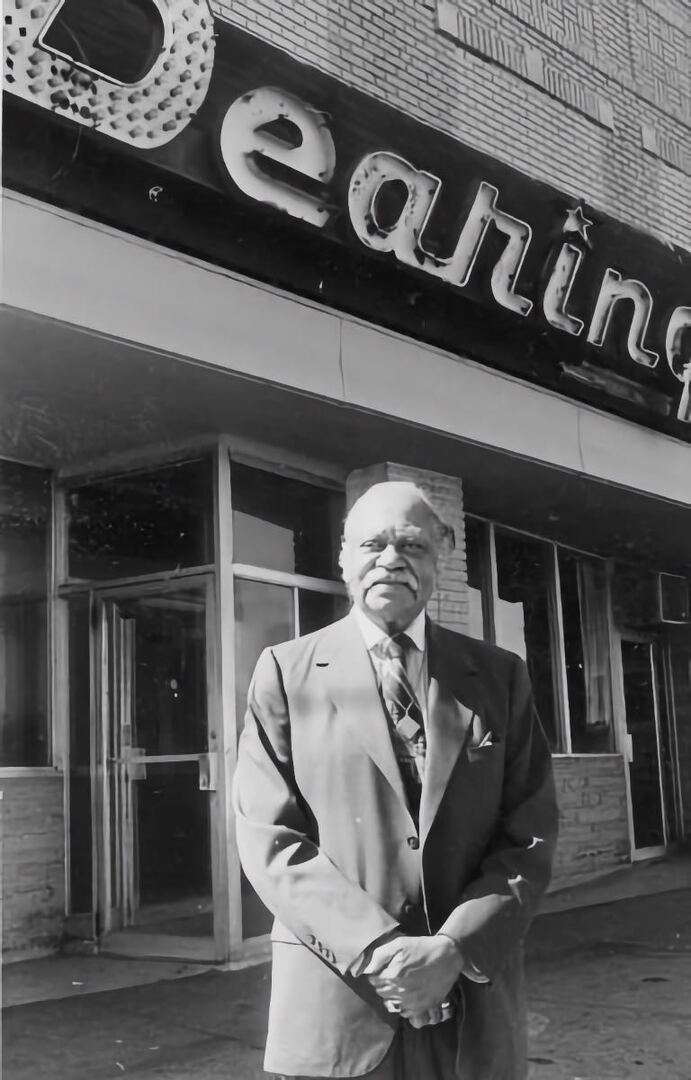
    <title type="html"><![CDATA[U. S. Dearing: Cleveland&#039;s  “Mister Restaurant”]]></title>
    <summary type="html"><![CDATA[<p><strong><em>In 1956, the <i>Call & Post</i>, Cleveland’s weekly African American newspaper, praised a leading light in the city’s restaurant field: “There is a double-star attraction featured by U. S. Dearing ... which has attracted the happy attention of approximately 65,000 Clevelanders during the past six months. Dearing’s double-feature is not a song and dance team or a couple of nationally famed stage stars; it is his Golden Brown Fried Chicken and his Hickory Smoked Barbecue.” So good was Dearing’s food that his wife, said to be a “fine cook” in her own right, confided to the paper that she usually served the restaurant’s food at parties in their 783 East Boulevard home: “I find it just too difficult to match the cooking that comes out of my husband’s kitchens,” she exclaimed.</em></strong></p><img src="https://www.clevelandhistorical.org/files/fullsize/eaf4757cad966edd111dcd2665e4ac21.jpg" alt="U. S. Dearing Outside His Last Restaurant" /><br/><p>Born in 1903 in Washington, Virginia, in the foothills of the Blue Ridge Mountains, Ulysses S. (“Sweets”) Dearing was abandoned at birth and raised by his uncle in a tarpaper shack. At age 14 he joined the Great Migration, arriving in Pittsburgh with no money and no formal education. After a stint working in a Carnegie Steel mill and as a butler, Dearing opened his own restaurant in the Hill District before buying and operating a small hotel there in the early 1930s. Soon thereafter, Dearing tried to open a restaurant and hotel in the rural outskirts of the city but suffered a flood that, with the weight of the Great Depression, returned him to financial ruin. </p><p>As a result, Dearing left the Steel City for the Forest City in 1932. According to a story he told often, Dearing arrived in Cleveland with 97 or 98 cents in his pocket, which he said he threw on the sidewalk after getting off the bus at East 107th Street and Euclid Avenue because he decided someone else might need it more than he. Over the next two years, Dearing worked as a short-order cook before eventually landing a job as the manager of the popular, Green Book–listed <a href="https://greenbookcleveland.org/locations/cedar-gardens/">Cedar Gardens</a> restaurant at 9706 Cedar, a Harlem-inspired “black and tan” club where jazz music brought the races together. There he earned the nickname “Prince of Green Pastures” because Cedar Gardens was the pulsing heart of an emerging upscale Black nightlife district that assumed this name upon the death in 1935 of Black actor Richard B. Harrison, beloved for his starring role in the Broadway hit <i>Green Pastures</i>.</p><p>Over the next decade, Dearing managed other entrepreneurs’ ventures, all of them featured in the <i>Green Book for Negro Motorists</i>, while struggling to launch his own. He managed Jack Hecht’s Cedar Gardens (1933–37), Benny Mason’s <a href="https://clevelandhistorical.org/items/show/967">Cedar Country Club/Mason's Farm</a> in Solon (1938–42), and Mason’s <a href="https://greenbookcleveland.org/locations/blue-grass-club/">Blue Grass Club</a> (1943–45). During his tenure at Mason’s Farm, Dearing briefly owned two restaurants of his own. First, he operated Dearing’s Tasty Shop (1938–39), formerly the <i>Green Book</i>–listed <a href="https://greenbookcleveland.org/locations/the-chicken-coop/">Chicken Coop</a>. Then he bought the Park Avenue Restaurant at 5622 Woodland in 1941 but owned it for less than a year. Dearing then opened his next Dearing’s at 9708 Cedar (next to Cedar Gardens) in the former Palace Cafe in 1943, but within a few months he had moved a block to the former site of <a href="https://greenbookcleveland.org/locations/club-ron-day-voo/">Club Ron-Day-Voo</a> at 9804 Cedar, where he remained until 1945. </p><p>Following the end of World War II, Dearing finally hit his stride, entering what was to turn out to be a nearly four-decade run. In 1946, he opened his newest Dearing’s restaurant at 1035 East 105th Street. His move to 105th, the main commercial thoroughfare running through Glenville, placed Dearing’s among the vanguard of Black-owned businesses in a neighborhood that was soon to transform from one of the city’s prime Jewish communities into the so-called “Gold Coast,” which supplanted “Green Pastures” as the most coveted address for upwardly mobile African Americans. For several years he shared his block with other illustrious Black-owned establishments, including <a href="https://clevelandhistorical.org/items/show/882">Cafe Tia Juana</a>, <a href="https://greenbookcleveland.org/locations/gold-coast-tavern/">Gold Coast Tavern</a>, and <a href="https://greenbookcleveland.org/locations/mercury-bar/">Mercury Bar.</a></p><p>Within a few years, Dearing had expanded to four locations that included the dining rooms Alonzo Wright’s <i>Green Book</i>–listed <a href="https://greenbookcleveland.org/locations/carnegie-hotel/">Carnegie</a> and <a href="https://clevelandhistorical.org/items/show/636">Majestic</a> Hotels, as well as in Club Amvets, which resurrected a former Dearing’s location at 9804 Cedar. He advertised citywide delivery service by 1949, although this effectively meant only a few square miles of the East Side at a time when the vast majority of African Americans still lived in either Cedar-Central or Glenville. Thereafter, with his own restaurant’s “shack fried chicken” and barbecued ribs having become wildly popular, Dearing scaled back to concentrate solely on his Glenville dining room. </p><p>Open 24 hours a day, Dearing’s flagship restaurant was known not only for its unforgettable fried chicken but also for its sumptuous Sunday dinners. One Sunday menu in 1953, for instance, included thirteen entree options — Roast Prime Rib of Beef Au Jus, Roast Young Hen Turkey with Gravy and Cranberry Sauce, Roast Loin of Pork with Candied Yams, Broiled Boston Lamb Chops on Toast Points, Baked Sugar-cured Ham with Fresh Fruit Sauce, Stewed Fresh Country Chicken Dublin Style, Roast Long Island Duckling with Stewed Apples, Sauce Baby Chicken Livers in Butter on Toast, Broiled Prime Boston Strip Steak with Mushrooms, Lobster a la Newburgh in Casserole, Saute Veal Sweet Breads with Fresh Mushrooms, Broiled Fresh Caught Lake Erie White Fish Maitre D’Hotel, Broiled Fresh Caught Red Snapper with Lemon Butter, and Fried Jumbo Frog Leg with Tartar Sauce — all modestly priced between $1.25 and $2.25. </p><p>The Glenville-based Dearing’s enjoyed a long run, proving so successful that Dearing began to expand with the assistance of his son U. S. Dearing Jr. In 1956, he opened Dearing’s Carry-Out Store, whose slogan was, “Your apartment is your dining room.” Between 1960 and 1970, Dearing’s added five additional locations: Dearing’s Chic-A-Rib Room (1960), later named Dearing’s Living Room Lounge, Mark I Lounge, Second Choice Lounge, and finally the Candlelight Room, in the former Gem Snack Bar & Bar-B-Q at 10932 Superior Avenue; Dearing’s Carry-Out (1963) at 12019 Ashbury Avenue; Dearing’s Continental Lounge (1968) at 12804 St. Clair Avenue; Dearing’s Party Center (1969) at 17324 Harvard Avenue; and finally Dearing’s Catering (1970), later known as the Mark III Lounge and Carry-Out, at 11223 St. Clair.</p><p>Amidst his overall expansion, Dearing sold his original Glenville restaurant in 1962 to his employee Grace Sears, but just two years later he bought back the building to attempt a new concept, Mr. D’s Pancake House, which offered more than 80 different pancakes and, like his original restaurant, was open around the clock. Just a year later, he pivoted again, turning it into Mr. D’s Seafood, but then he abruptly closed down before the end of 1965. Perhaps these more specialized eateries fell short of expectations with pancakes mainly appealing in the morning hours and seafood costing more. </p><p>For the remainder of the decade, Dearing’s overall enterprise continued to prosper. However, no sooner had Dearing reached the zenith of being proprietor of his own local chain than he began to scale back. In 1971, he phased out the Continental, and he also shuttered his carry-out on East 105th following a devastating fire in 1972. Four years later, he closed the Mark III on St. Clair and, soon after on the advice of his doctor, in 1977 he also sold the Party Center to Edward Haggins and Dale Carter, with whom he shared his famous fried chicken recipe. Carter then carried on the Dearing’s tradition in Lee-Harvard, first as Dearing’s Lounge and then as Juva De’, which featured musical acts like the O’Jays.</p><p>Dearing, meanwhile, spent his remaining years concentrating on his Candlelight Room at Superior and East 110th, which operated until a few months before his death in 1984. Although only one of the Dearing’s buildings (the one in Lee-Harvard) stands today, Dearing’s legacy lives in the memory of many who remember his culinary prowess and warm hospitality. It is therefore little surprise that the <i>Cleveland Press</i> dubbed him “Mr. Restaurant,” rightly recognizing Dearing’s reputation as one of and possibly<i> the </i>foremost Black restaurateur of the twentieth century in Cleveland.</p><p><em><strong><a href="https://www.clevelandhistorical.org/items/show/1073">For more (including 13 images) view the original article</a></strong></em></p>]]></summary>
    <published>2025-11-24T12:44:21+00:00</published>
    <updated>2026-04-04T22:12:10+00:00</updated>
    <link rel="alternate" type="text/html" href="https://www.clevelandhistorical.org/items/show/1073"/>
    <id>https://www.clevelandhistorical.org/items/show/1073</id>
    <author>
      <name>J. Mark Souther</name>
    </author>
  </entry>
  <entry>
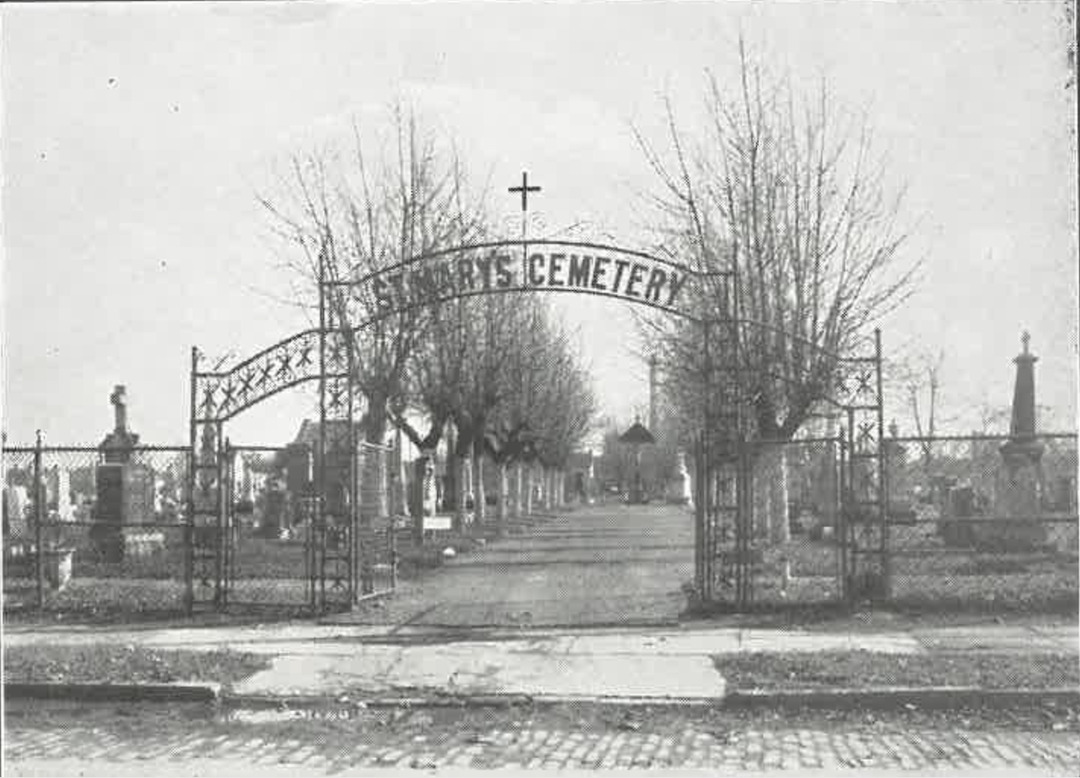
    <title type="html"><![CDATA[St. Mary Cemetery: Cleveland&#039;s First West Side Catholic Cemetery]]></title>
    <summary type="html"><![CDATA[<p><strong><em>St. Mary Cemetery lies in the middle of one of the most densely populated residential areas on Cleveland's west side. Its nine acres of land, dotted with shade trees and beautiful grave stones, is surrounded by a fence, and, at its West 41st Street entrance, a posted sign advises visitors of its visiting hours.  However, neither this entrance nor its other on West 38th is gated. This being the case, St. Mary's almost beckons to neighbors and any other passersby to  visit it at any time, day or night, enjoy its grassy grounds, walk its pretty paths, and, most importantly, respect its magnificent  monuments.</em></strong></p><img src="https://www.clevelandhistorical.org/files/fullsize/1cc9a1a467673d53392c76e36c48e8e6.jpg" alt="The once ornate West 41st Street entranceway to St. Mary Cemetery." /><br/><p>In 1853, just one year before Ohio City was annexed to the City of Cleveland, thus becoming Cleveland's west side, prolific nineteenth-century real estate developer Hiram Stone platted a new residential subdivision south of Ohio City in Brooklyn Township. He called it "H. Stone's Addition to Ohio City & Cleveland," a remarkably prescient title at the time. The new subdivision stretched west from Pearl (West 25th) Street all the way to Gauge (West 44th) Street, and from Clark Avenue north to <a href="https://clevelandhistorical.org/items/show/659">Walworth Run</a> at Ohio City's southern boundary. </p><p>The platted area contained almost 700 lots for residential houses, but left undeveloped in its midst were thirteen acres located just east of Burton (West 41st) Street and north of Clark Avenue. In 1861, as houses were going up in Stone's subdivision—many of them for German immigrants who were pouring into Cleveland in this period in large numbers—the southernmost six acres of the undeveloped thirteen in the middle of the subdivision were purchased by the Catholic Diocese of Cleveland for, according to the deed of purchase, "cemetery purposes for the benefit of German Catholics on the west side of the Cuyahoga River." </p><p>Many of the early records of St. Mary Cemetery appear to have been destroyed in a fire, making research of the early years of the cemetery difficult.  However, secondary sources tell us that St. Mary Cemetery was established on those six acres of land in 1862 by St. Mary of the Assumption parish, Cleveland's first west side German Catholic parish. The property for St. Mary Cemetery was purchased during the pastorship of Father F. X. Obermueller, a German immigrant, but it appears that it was under a subsequent pastor, Father Stephen Falk, a Swiss immigrant who served the parish from 1862 to 1880, that the cemetery grounds were developed and consecrated. In St. Mary Cemetery's early years, it was often referred to as Burton Street Cemetery, after the street upon which it fronted. That street, in turn, had been named after <a href="https://clevelandhistorical.org/items/show/660">William Burton</a>, an Ohio City pioneer whose summer cottage was built on the street in 1839 and still stands directly across from St. Mary Cemetery.  </p><p>Just a few years after St. Mary Cemetery opened, another German Catholic parish, <a href="https://clevelandhistorical.org/items/show/649">St. Stephen</a>, was established on Cleveland's west side. It began in 1869 as a mission of St. Mary of the Assumption for German Catholics living west of Gauge (West 44th) Street. A decade later, in 1881, another parish, <a href="https://clevelandhistorical.org/items/show/717">St. Michael Archangel</a>, was also founded as a mission of St. Mary's for German Catholics living on Cleveland's southwest side. In the years that followed, German Catholics who belonged to either St. Mary of the Assumption, St. Stephen or St. Michael's parishes were permitted to be buried at St. Mary Cemetery which, by this date, had now become part of Cleveland's west side following the 1867 annexation of an area of Brooklyn Township that included the lands upon which the cemetery was located.</p><p>It is interesting to note that no Cleveland newspaper mentioned St. Mary Cemetery during the first decade of its existence. The first to mention the cemetery, albeit obscurely, was the Plain Dealer on May 30, 1871, when it published an article which noted that, on Decoration Day, Father Falk of St. Mary's German church had, at the west side "Catholic cemetery," decorated the graves of "J. Mayer, J. Schneider, F. Werz, A. Klein, K. Mecil, B. Lais, F. Schwonger, S. Vochatger, C. A. Schmidt, and Jas. Macklin." All of these men presumably were German Catholics who had fought for the Union—and for which some had died—in America's Civil War. Cleveland city directories were even slower in acknowledging the existence of the new cemetery. St. Mary Cemetery was not listed in any Cleveland directory until 1874.</p><p>Thousands of German immigrants and descendants of German immigrants were buried at St. Mary Cemetery in the years that followed its establishment, many of them beneath beautiful gravestones inscribed in the German language. A number of these gravestones are memorials to notable German Catholics who, in the second half of the nineteenth century, operated successful retail businesses on Lorain Avenue near Fulton Road, an intersection that soon became known as <a href="https://clevelandhistorical.org/items/show/966">Lorain-Fulton Square</a>. A number of those gravestones honor members of the related Fridrich and Schmitt families who operated several different businesses in that west side commercial district, including <a href="https://clevelandhistorical.org/items/show/964">Fridrich Bicycle</a>, one of the oldest retail bicycle shops in the United States until it closed its doors in 2024. </p><p>Another example of a notable German immigrant businessman buried at St. Mary Cemetery is Friedlin "Freddie" Hirz (1843-1903), a tailor who for years had a shop on Lorain Avenue, just west of what is today West 45th Street. His shop was so well known that it was featured in the 1874 Atlas of Cuyahoga County. Another is Edward Disler, a German immigrant and jeweler who successfully operated a store on Lorain Avenue near West 25th Street for many years.</p><p>While St. Mary Cemetery was explicitly founded for German Catholic burials, Catholics of other ethnicities were later given permission to bury their dead there too. The first of these were Bohemian Catholics many of whom lived near the cemetery in a west side neighborhood that was known in the second half of the nineteenth century as the <a href="https://clevelandhistorical.org/items/show/646">Isle of Cuba</a>. The early-arriving immigrants likely first worshiped with German Catholics at either St. Mary of the Assumption or St. Stephen, but, by 1872, their numbers were sufficiently large that the Bishop permitted them to form a parish of their own, which they called <a href="https://clevelandhistorical.org/items/show/661">St. Procop</a>, after Bohemia's patron saint. Their first church was built on Burton Street, just south of St. Mary Cemetery in 1874. One of the earliest verifiable burials of a Bohemian Catholic at St. Mary Cemetery occurred in 1892, when 41-year- old Miloslav Holecek, a Cleveland grocer and immigrant from <span>Karlova Huť in Central Bohemia</span>, died and was buried there. His gravestone, as well as those for a number of other Bohemian immigrants buried at St. Mary's, is inscribed entirely in the Czech language.</p><p>In the early years of the twentieth century, Catholic immigrants of other ethnic groups from Central Europe who often tended to settle in urban areas where Germans and/or Bohemians had first settled, including Hungarians, Poles, and Slovaks, became members of the west side German and Bohemian Catholic parishes, and when they died, they were permitted to be buried at St. Mary Cemetery too. Their gravestones were often inscribed in their native languages.</p><p>In 1917, Father Casimer Reichlin, the first pastor of St. Stephen who had served for an incredible 47 years, died.  By this time, there appears to have already been a large circular section near the West 41st Street entrance to St. Mary Cemetery, in the center of which a large cross had been erected. It further appears that it was decided that this beloved pastor should be buried in that section, with a large sculpted monument erected over his grave. Four years later, Father Reichlin's long-time friend and fellow priest, Bishop Joseph Koudelka, who had been a pastor at both St. Procop and St. Michael, died and was buried next to Father Reichlin's grave in the circular section. A similarly sized sculpted monument was placed over his grave too. Soon this circular section of St. Mary Cemetery became known as the Priests Circle. In the years that followed, other notable local priests who had served west side Catholic parishes were accorded the same honor and buried in the Priests Circle, some below large monuments and others below simple flat grave markers. As of October 2025, there were eleven priests buried in the Priests Circle. Father Stephen Falk, whose efforts led to the development of the cemetery and its consecration in 1862, is not buried in the Circle, as he died in 1899 long before the Priests Circle was initiated. A simple flat grave marker in Father Falk's memory, which apparently replaced a more elaborate earlier monument, is located in another section of St. Mary Cemetery.</p><p>By the early 1920s, there were few available burial plots left at St. Mary Cemetery. The parish of St. Mary of the Assumption decided to remedy this by expanding the cemetery's lands, and in 1927 and 1928 it successfully purchased three additional acres of land for the cemetery that abutted the eastern end of the original cemetery grounds.  The additional acres had earlier been developed as residential lots in H. Stone's Additional Subdivision. Houses on the lots were either torn down or moved, and the cemetery grounds were successfully extended all the way to West 38th Street. Along with the additional land, St. Mary Cemetery was further enhanced at this time with a second entrance on West 38th Street and a new walking path that led from that entrance directly to a new circular section in the cemetery.</p><p>On November 15, 1931, the new addition to St. Mary Cemetery was consecrated at a ceremony attended by a representative of Bishop Joseph Schrembs.  Some five years later, on May 17, 1936, the Cuyahoga County Council of the Veterans of Foreign Wars placed a flagpole and a memorial plaque in the center of the new circular section, the plaque inscribed: "Dedicated To The Veterans Who Served . . . Lived . . . Died . . . for their Country."  </p><p>As previously noted, St. Mary Cemetery had long held the graves of a number of German Catholic soldiers who fought and died in the Civil War, and also likely holds graves of soldiers and veterans who had fought in the Spanish-American War and/or in World War I. No veterans from any of these war, however, are buried in this new circular section. The first soldier buried in what became known as the Soldiers Circle, was Charles L. Andrews, a U. S. Navy radio operator who was killed on Easter Sunday, April 5, 1942, during the Battle of Bataan in the Philippine Islands. The remains of sixteen other soldiers or veterans who served in World War II were also buried in the Circle between 1942 and 1948.</p><p>In 1945, as a result of dwindling attendance numbers, St. Mary of the Assumption parish was dissolved and, in 1948, the management, care and maintenance of St. Mary Cemetery was transferred to the Calvary Cemetery Association, an organization which was later renamed the Catholic Cemeteries Association of the Cleveland Diocese. By the early 1950s, the last of the available lots in the cemetery were purchased, and, by 1976, according to a January 21, 1976 Plain Dealer article, the number of annual burials at St. Mary Cemetery had dropped to just fifty.  Today, in 2025, the annual numbers appear to be considerably less. According to findagrave.com—a website at which volunteers create memorials for people whose remains have been buried in cemeteries all around the world—the remains of only nine deceased persons have been buried at St. Mary Cemetery since 2020.  </p><p>St. Mary Cemetery is no longer the active burial place for west side Catholics that it once was. Burials are now few and far between. The cemetery's elaborate gate that once stood at its West 41st Street entrance in 1929 is gone. The sacred monuments to Father Reichlin, Bishop Koudelka and Father Falk have been substantially damaged, likely by vandals. The cross in the middle of the Priests Circle, which stood there for years until recently, is now gone. Acts of vandalism, as noted in a number of Plain Dealer and Press articles over the years, and the effects of exposure of the cemetery's monuments to Cleveland's weather over long periods of time, have left many monuments damaged and unreadable while many others have simply vanished. Still, St. Mary Cemetery remains one of the most historic cemeteries on Cleveland's west side and one which should be visited, respected, and carefully managed and maintained, not only for the descendants whose ancestors are buried there, but also for all Clevelanders who see value in preserving an important piece of their city's history.</p><p><em><strong><a href="https://www.clevelandhistorical.org/items/show/1072">For more (including 15 images) view the original article</a></strong></em></p>]]></summary>
    <published>2025-11-23T16:18:32+00:00</published>
    <updated>2026-03-04T21:32:06+00:00</updated>
    <link rel="alternate" type="text/html" href="https://www.clevelandhistorical.org/items/show/1072"/>
    <id>https://www.clevelandhistorical.org/items/show/1072</id>
    <author>
      <name>Jim Dubelko</name>
    </author>
  </entry>
  <entry>
    <title type="html"><![CDATA[Hermit Club : The Evolution of Cleveland&#039;s Oldest Private Club Dedicated to the Performing Arts]]></title>
    <summary type="html"><![CDATA[<img src="https://www.clevelandhistorical.org/files/fullsize/ca4a7f164a9b812e223d53fcf1c3bdfc.jpg" alt="Second Hermit Club" /><br/><p>The Hermit Club was founded in 1904 by Cleveland architect Frank B. Meade, who was inspired by a visit to New York City's Lambs Club, a private social club devoted to the performing arts. After returning to Cleveland, Meade envisioned a similar space to serve the city's musicians and actors. He designed a clubhouse in a British pub style modeled after the Lambs Club.</p><p>Meade and his associates recruited members from all over Cleveland, notably from the Gatling Gun Company, which employed many musicians and performers. A budget of $10,000 was set for constructing a clubhouse on <a href="https://clevelandhistorical.org/items/show/806">Hickox Alley</a> (now East 3rd Street), near the Euclid Avenue Opera House, then the center of Cleveland's theater district. The building's brickwork, leaded windows, and floral wood engravings evoked its English inspiration. </p><p>From its beginning, the Hermit Club was both ambitious and exclusive. By 1909 it had grown large enough to need a bookkeeper, and its annual dues increased from $20 to $60, a substantial sum at the time. This high membership fee ensured that members were affluent and dedicated to musicianship and performance. The Club formed house and finance committees by 1910 to organize events and collaborations. </p><p>The Hermit Club quickly became a center for musical performance. Under the leadership of Meade, himself a trained musician, the Club featured musical concerts by the Original Fadette Jazz Orchestra, which included five violinists, a cellist, a bass violist, a clarinetist, a cornetist, and two pianists. The Club's first production, Hermits in Holland, set the tone for other musical "pilgrimages," including performances set in Spain, Austria, Mexico, Africa, California, the American South, and so forth. These location-specific shows involved elaborate costumes, makeup, and acting as the Hermits tried to embody the cultures they portrayed on stage. By the mid-1920s, the Hermit Club hired an orchestra conductor and began composing original music. </p><p>The Hermit Club also played a notable role in Cleveland's civic and charitable life. Proceeds from early productions supported causes such as the Cleveland Day-Nurse Premature-Babies Dispensary and the Hospital of Cleveland. The Club shared costumes and resources with other organizations, hosted “ladies' nights,” fielded its own baseball team, and even branded tobacco and cigarette boxes. In 1911, the Club began accepting junior members between the ages of 21 and 23, offering them reduced dues and training from senior members, all in an effort to connect with colleges and engage younger performers. </p><p>The Club also adapted to legal and social change. When Ohio adopted prohibition in 1912, the Club halted its alcohol sales, resuming only after repeal in 1933. Membership held steady at around 100 members, but it then dropped during World War II when 40 members left for military service. After the war, membership rebounded. In 1971, the Hermits voted to permit women to attend meetings and participate formally, though women had long been present at some social events and galas. </p><p>A major physical change came in 1928, when the Hermit Club sold its original clubhouse as demand for office and retail space intensified on lower Euclid Avenue. The Club followed the eastward drift of Cleveland's entertainment district to Playhouse Square, building its new clubhouse at 1628 Dodge Court in a similar Tudor style to that of the original. Although Meade stepped down as the Club's president in 1938, the organization he founded continued to thrive. </p><p>In more recent decades, the Hermit Club maintained its status as a private institution with roughly 100 dues-paying members. Its biggest modern transformation came in 2016, when a 50-seat public restaurant serving German cuisine opened inside the building. While most of the clubhouse remains private, the restaurant allows non-members to experience the space and learn about Cleveland's cultural legacy. The Club has also maintained its musical tradition, contributing performances honoring figures such as Judy Garland and Frank Sinatra. </p><p>More than a century after its founding, the Hermit Club remains a living testament to Cleveland's artistic heritage. Like Playhouse Square, it nurtures a performance culture interwoven with civic engagement while providing a place for people to enjoy food and music.</p><p><em><strong><a href="https://www.clevelandhistorical.org/items/show/1070">For more (including 10 images) view the original article</a></strong></em></p>]]></summary>
    <published>2025-11-18T19:35:38+00:00</published>
    <updated>2026-03-28T21:23:14+00:00</updated>
    <link rel="alternate" type="text/html" href="https://www.clevelandhistorical.org/items/show/1070"/>
    <id>https://www.clevelandhistorical.org/items/show/1070</id>
    <author>
      <name>Jordan Gallegos </name>
    </author>
  </entry>
  <entry>
    <title type="html"><![CDATA[Fine Arts Building : Cleveland Attempts to Create New Greenwich Village]]></title>
    <summary type="html"><![CDATA[<p><strong><em>The Fine Arts Building was Cleveland's answer to similar artist-oriented developments in New York and Chicago. Reflecting the vision of two brothers who emigrated from the Russian Empire, this Millionaires' Row mansion–turned–miniature artists' colony mimicked the bohemian spirit of New York's Greenwich Village.</em></strong></p><img src="https://www.clevelandhistorical.org/files/fullsize/b329f71271c960e9825209c2ba3dfd00.jpg" alt="The Fine Arts Building in 1940" /><br/><p>The Fine Arts Building opened in 1921 to great fanfare. Located on Euclid Avenue between East 30th and East 36th Streets in the historical stretch of Millionaires’ Row, the Fine Arts Building was built in an era of great change in Cleveland. By the 1920s, Millionaires’ Row was starting to lose the eponymous millionaires who developed the area, as Euclid Avenue became more focused on commerce.</p><p>The Fine Arts Building started as the mansion of John Henry Devereux. Originally built in 1873 for Devereux, a U.S. Army general in the Civil War, the mansion remained home to the Devereux family until his widow Antoinette passed away in 1915. As the city changed and Euclid Avenue lost its luster in the eyes of local elites, its old mansions were usually torn down, but the Devereux mansion did not meet that same fate. Instead, six years after Antoinette Devereux's death, it was repurposed as a self-contained arts colony.</p><p>The Fine Arts Building was the brainchild of two Cleveland brothers, A. A. and Max Kalish. A. A. Kalish was a real estate dealer and his brother Max was a renowned artist. The Kalish brothers were born in Minsk in the Russian Empire (present-day Belarus) into an Orthodox Jewish family. Their father immigrated to the U.S. in 1894, and the rest of the family followed four years later. Max, having shown artistic talent early on, later won a scholarship to the Cleveland Institute of Art. After a stint in the Army in World War I, he split his time between Europe and the U.S. until World War II, when he had to return to the U.S. permanently.</p><p>The melding of the business and art worlds had its roots in New York City, and the Cleveland Fine Arts Building reflected this. The primary models for the Cleveland Fine Arts Building were the Tenth Street Studio Building in New York City and Chicago’s Fine Arts Building. Both places, as would happen in Cleveland, combined the creation of art and use of a building to showcase and sell the art produced there.</p><p>The concept of fine arts buildings began in the mid-19th century in New York City. In the 1850s a building was constructed on 10th Street that ended up housing a wide range of artists, such as Winslow Homer and Frederic Church. It was the first such building in the world. It was from this building that Greenwich Village gained its reputation as a center for artistic and bohemian lifestyles. As in Cleveland 60 years later, the Tenth Street Studio Building was developed by two brothers, in this case, businessman Richard Morris Hunt and artist William Morris Hunt.</p><p>The reason that places such as the Fine Arts Building were built was to bring together the world of art and commerce. They provided artists space to work, as well as a place to sell their works. This was especially important in the era before a lot of artists had agents to sell their work for them. </p><p>The Cleveland Fine Arts Building lasted for less than fifteen years as an artists' building. After the mid 1930s, it continued as an apartment building. The front of the building hosted various businesses over the years, as well. In the late 1950s there was a family-owned deli, and various other businesses occupied its street-level spaces into the 21st century.</p><p><em><strong><a href="https://www.clevelandhistorical.org/items/show/1067">For more (including 6 images) view the original article</a></strong></em></p>]]></summary>
    <published>2025-11-18T19:17:44+00:00</published>
    <updated>2026-03-04T21:32:06+00:00</updated>
    <link rel="alternate" type="text/html" href="https://www.clevelandhistorical.org/items/show/1067"/>
    <id>https://www.clevelandhistorical.org/items/show/1067</id>
    <author>
      <name>Josh Forquer</name>
    </author>
  </entry>
  <entry>
    <title type="html"><![CDATA[Geauga County Courthouse: From Log Cabin to Landmark on the Chardon Square]]></title>
    <summary type="html"><![CDATA[<p><strong><em>Resilience, perseverance, and dedication to history drive Chardon residents to continue improving their beloved courthouse, which has served as the seat of governance for Geauga County since 1805.</em></strong></p><img src="https://www.clevelandhistorical.org/files/fullsize/9ad50285c8e25a45f5fa52bd2fdf78b4.jpg" alt="The Fourth Geauga County Courthouse" /><br/><p>Chardon’s early planning began with Peter Chardon Brooks, a wealthy Boston merchant who acquired land from the Connecticut Land Company in 1798. He offered the land to settlers with the only stipulation being to name it Chardon. The commissioners accepted this proposal in 1808. Before Chardon could be settled, one matter of prerequisite importance had to be addressed – the establishment of a permanent seat of justice for the Geauga County. The commissioners of the county's Common Pleas Court then assigned Samuel W. Phelps to purchase and lay out land for this purpose. Reflecting New England ideals of structure and order, in 1808, the first building to be erected in Chardon was a courthouse.  </p><p>Reflecting the realities of frontier life, however, this first “courthouse” was little more than a repurposed log cabin, originally built by Abraham Skinner for Captain Edward Paine Jr. and his family. The one-room building was primitive, with a single door and window, a basic fireplace and chimney, and wide, rough boards for flooring. It also served as a temporary jail. It had a large, split log that functioned as a seat for the judges and a single large table providing a desk for the lawyers.  Realizing that the log cabin had served its temporary functions, the time came for a larger courthouse. </p><p>In 1813, Samuel King was contracted to build the second courthouse where the fire station currently stands on the square. It was built of rugged timber and had two floors. The first floor housed one cell as a temporary jail, and the second floor was the courtroom. The courthouse had multiple additional functions as Chardon was being built up. It also served as a meeting hall for political, religious, and social gatherings, as well as providing a school room for the few children who lived in Chardon. </p><p>By 1824, village leaders realized that Chardon needed better quarters for the county offices. The county allotted funds to build the southern half of the third courthouse, which also served as a jail. It was not until 1829 that the northern half of the courthouse was completed. Built of bricks in Greek Revival style, this two-story building featured large columns on the front portico. Its increased architectural sophistication mirrored the growing wealth of the county and its businesses. Unfortunately, this courthouse was not to last. </p><p>On July 25, 1868, the <em>Cleveland Plain Dealer </em>reported terrible news: “the whole business portion of Chardon, including the courthouse and jail, were burned last night.” The damage was not only material, estimated at the then-enormous sum of $100,000, but also functional; the loss of the official county buildings cast uncertainty of Chardon’s future as the county seat.  </p><p>After the fire, Chardon's citizens refused to give up. The county quickly issued a contract to Messrs, Herrick & Simmonds of Cleveland to rebuild the business district and courthouse. A newspaper article from December 4, 1868, reported on the rebuilding of Chardon: “When the improvements are completed, Chardon will become one of the handsomest villages in the State.” Another newspaper article from January 29, 1869, raved about “Chardon rising from her ashes. A disaster transformed into a blessing.” By this time, six months after the disaster, Chardon had already established a building committee, secured funding, and had built Union Block (now Main Street) on the former ruins, as well as the Randall Block (now South Hambden Street), a new section that expanded the business district around the square. The highlight of rebuilding was the courthouse, now located at the head of the public square. </p><p>Unlike its predecessors, the architecturally picturesque fourth Geauga County Courthouse, with its octagonal steeple and interestingly designed windows, endures. Faced with brick and stone trim, the North Italianate building cost $88,862. The courthouse and the two blocks of storefronts to its west form a historic district listed on the National Register of Historic Places. The square tower, detailed cupulas, and dome give this building its distinctive look. The dome roof with clock faces on four sides and its weathervane are the crowning features. Chardon had built a courthouse to match the prestige of the town and its importance in Geauga County.     </p><p>In 2020, city officials began to discuss the need to expand the courthouse. The county's judiciary had outgrown the building, which needed not only structural renovations but also technological upgrades, especially to security features. More than a century and a quarter after the current courthouse was built, Chardon residents remained protective of their historic buildings. Originally, when it was proposed for the courthouse to get an addition, residents and the Chardon Square Association sent letters opposing the expansion. County Commissioner Janet Novak acknowledged that the community had “strong feelings” about historic Chardon Square and that “any change to the square was a sensitive subject.” These concerns delayed the expansion project for years. </p><p>In 2023, city officials and Chardon residents finally reached an agreement on the expansion. As the project neared completion in 2025, Commissioner James Dvorak, a retired Chardon bricklayer and stonemason, applauded city leaders’ willingness to prioritize the historic preservation of a building whose “Italianate arches and towers have defined Chardon Square for more than 150 years,” which meant that the addition to the courthouse had to blend with the existing structure. Dvorak noted that. the county returned to the same Cleveland-area quarry used in the 19th century to source Berea sandstone to ensure that the expansion matched the original. The latest addition to the Geauga County courthouse shows how much history means to the residents of Chardon. </p><p>As Chardon grows, residents still treasure its historical atmosphere. A newspaper article from 1902 boasted of “Chardon, typical New England village. Ideal place to live. Good churches, good schools, good water, and good air.” This statement still holds true well over a century later. People move to Chardon because it is safe, beautiful, and a good place to settle with children. This is true of Chardon because of the resilience, perseverance, and good nature of the people that have lived here since its founding in 1805. Chardon has been strong for a couple hundred years, and at the pace it's going, it will remain strong into the future.</p><p><em><strong><a href="https://www.clevelandhistorical.org/items/show/1066">For more (including 9 images) view the original article</a></strong></em></p>]]></summary>
    <published>2025-11-13T19:37:34+00:00</published>
    <updated>2026-03-04T21:32:06+00:00</updated>
    <link rel="alternate" type="text/html" href="https://www.clevelandhistorical.org/items/show/1066"/>
    <id>https://www.clevelandhistorical.org/items/show/1066</id>
    <author>
      <name>Jez Lambert</name>
    </author>
  </entry>
  <entry>
    <title type="html"><![CDATA[Hart &amp; Co. Building: How One Building Helped Save a Struggling District]]></title>
    <summary type="html"><![CDATA[<p><strong><em>By 1980, 40 percent of the structures in the Warehouse District were gone. John Cimperman, head of the Cleveland Landmarks Commission,  summed up the situation best when he stated, “We need luck, money, and cooperation, but saving and restoring this area is [a] must.” The Hart & Co. Building was a starting point for the restoration of the Warehouse District in a broader trend of adaptive reuse.</em></strong></p><img src="https://www.clevelandhistorical.org/files/fullsize/36069c526aa18707bd0098b219f3c1fe.jpg" alt="Hart &amp; Co. Building in 1897" /><br/><p>The Hart & Co. Building is located at 1235 West 6th Street in the Warehouse District and currently contains the Hat Factory Lofts and Richardson Design. The Hart & Co. Building was commissioned in 1888 by Elbert Irving Baldwin, one of the city’s oldest dry goods merchants, who came to Cleveland in 1857. The building’s first tenant was E. L. and F. W. Hart & Co., which leased the building until 1900. Hart & Co. was one of the most prominent millineries in a millinery market that ranked third in the nation (behind New York and Chicago) by 1895. Hart & Co. made hats for women and imported hats and materials from Europe. Hart & Co. sold straw, felt goods, feathers, flowers, ostrich plumes, ribbons, silk, velvets, ornaments, and other goods for making hats; many of these items the company sold made their way to the “far west and extreme south.” Furthermore, in 1897 it was reported that thousands of milliners (most of whom were women) came to Cleveland each year from Ohio, Indiana, Kentucky, Michigan, and Pennsylvania to see the latest spring hat designs. </p><p>On April 15, 1899, catastrophe struck Hart & Co. At noon, a fire erupted in the building occupied by Comey & Johnson behind the Hart & Co. Building. The fire threatened the entire block bounded by West St. Clair Ave and West Lakeside Avenues and West 3rd and West 6th Streets. Eventually, the fire spread to the Hart & Co. Building; by 1:00 p.m. the building was “doomed.” The heaviest loss was suffered by Hart & Co. whose building was a wreck, with damage estimated at approximately $75,000. In 1899, the building was rebuilt and redesigned by F. S. Barnum and Co. and Hart & Co. moved and rented out the Brush Building. It is unclear whether the entire building was destroyed or if only parts of it were destroyed. What is certain is the building suffered significant damage from the fire.</p><p>In 1900, the building was sold to Adams & Ford, a wholesale dealer in rubber goods that primarily made boots and shoes. In 1941, White Tool & Supply Co. bought the building and used it as a warehouse until 1983. White Tool & Supply Co. seemed especially prosperous in the 1950s. In July 1951, it was reported that the company sold more than $3,000,000 of tools, equipment and machinery each year. Business likely declined from the 1960s to 1980s as many of the businesses in Cleveland (and elsewhere) saw a decline due to deindustrialization and urban decline. Additionally, other factors that led to the decline of the machine tools industry included the failure to modernize/innovate, the failure to sell internationally, bigger companies buying smaller companies in the industry, and the dismantling of the iron and steel industry, which was linked with the machine tool industry. Hence, many buildings in cities became vacant/abandoned and left to deteriorate. The solution many cities implemented due to the crisis of deteriorating structures was demolition. From the 1940s to 1970s, approximately one-third of the buildings in the Warehouse District were cleared and replaced with surface parking. By 1980, 40 percent of the structures in the Warehouse District were gone. </p><p>In 1971, in response to demolition in Cleveland, the Cleveland Landmarks Commission was formed. The Landmarks Commission’s mission was to find architecturally and historically significant buildings in Cleveland and label them as landmarks to prevent their demolition. In April 1977, John D. Cimperman, head of the Landmarks Commission and Cleveland City Council member, revealed a plan for the Warehouse District that focused on reusing buildings through renovations and creating urban housing. Cimperman was aware of the historic value of the Warehouse District: it contained early commercial skyscrapers and much of the early wealth acquired in Cleveland was earned in the district. Cimperman summed up the situation best when he stated, “We need luck money, and cooperation, but saving and restoring this area is [a] must.” In 1982, the Warehouse District gained further protection from destruction. That year, Cleveland City Council established the Warehouse Historic District and the National Park Service approved listing the Warehouse District in the National Register of Historic Places. However, in 1983, White Tool & Supply Co. left the Hart & Co. Building, leaving its fate in question. </p><p>Luckily, on January 8, 1984, the Cleveland City Planning Commission approved an Urban Development Action Grant proposal for the building and in March, the U.S. Department of Housing and Urban Development approved the application. This meant funds of $800,000 and a $2 million mortgage were approved to help restore and repurpose the building. The renovation was undertaken by the Old Cleveland Properties division of the Dalad Group and turned into an apartment building with thirty-three loft-style suites. The first floor was used as a commercial space where a restaurant and tavern were expected to be installed. Additionally, the developers tried to keep elements of the industrial history of the building but also made it look like a cozy residential space. In June 1985, the Hat Factory Lofts opened. Thus, the Hart & Co. Building began its life as the first legal housing unit in the Warehouse District. </p><p>The transformation of the Hart & Co. Building into the Hat Factory Lofts was the first step in the spread of adaptive reuse in the Warehouse District. The Hat Factory Lofts was one of twenty-one buildings the Dalad Group planned to develop in the Warehouse District. Additionally, there were plans to establish pedestrian walkways and courtyards in the district to make it pedestrian friendly and to transform it into a mixed-use neighborhood. In 1987, Old Cleveland Properties undertook a $3 million renovation of the Hoyt Block, a four-story Victorian building. This led to the creation of eighty thousand square feet of retail space at ground-level and upper-floor offices. In 1988, Old Cleveland Properties made fifty-six apartments out of upper-story space in the Hoyt Block. In 1990, only three buildings in the Warehouse District had apartments: the Bradley Building, Hat Factory Lofts, and the <a href="https://clevelandhistorical.org/items/show/1062">Hart Building</a>. Hence, the adaptive reuse of the Hart & Co. Building paved the way to revitalize the Warehouse District and served as part of the national trend to use adaptive reuse to save struggling cities like Baltimore, Minneapolis, and Pittsburgh. In the end, the Hat Factory Lofts tips its hat to the building’s first inhabitant, Hart & Co., through its name and architectural features, continuing to provide a sense of Cleveland’s past as the city continues to live on.</p><p><em><strong><a href="https://www.clevelandhistorical.org/items/show/1064">For more (including 8 images) view the original article</a></strong></em></p>]]></summary>
    <published>2025-11-13T19:36:21+00:00</published>
    <updated>2026-03-04T21:32:06+00:00</updated>
    <link rel="alternate" type="text/html" href="https://www.clevelandhistorical.org/items/show/1064"/>
    <id>https://www.clevelandhistorical.org/items/show/1064</id>
    <author>
      <name>Casey Smith</name>
    </author>
  </entry>
  <entry>
    <title type="html"><![CDATA[The Shaker Players: Behind the Footlights]]></title>
    <summary type="html"><![CDATA[<p><strong><em>Community theater has long been a hallmark of American civic life, offering ordinary people the opportunity to create extraordinary art together. Few local institutions embody this spirit as fully as The Shaker Players, a theater group rooted in Shaker Heights, Ohio. From their humble founding in 1919, the Shaker Players evolved into one of the oldest community theaters in Northeast Ohio, leaving an indelible mark on the region’s cultural landscape. Their story is one of tradition, collaboration, and a devotion to keeping theater accessible to all.</em></strong></p><img src="https://www.clevelandhistorical.org/files/fullsize/179a9e15266e8a5e5ed97b9794038f43.jpg" alt="Shaker Players Diorama" /><br/><p><span class="NormalTextRun SCXW42064403 BCX0">The Shaker Players trace their origins to </span><a href="https://clevelandhistorical.org/items/show/359"><span class="NormalTextRun CommentStart CommentHighlightPipeRest CommentHighlightRest SCXW42064403 BCX0">Plymouth Church</span></a><span class="NormalTextRun CommentHighlightPipeRest SCXW42064403 BCX0"> in Shaker Heights. In 1919, a small group of young church members organized a play to raise funds for a new church building. They could hardly have known that this modest effort would grow into a community theater organization lasting for decades. From the start, the group drew on a wide cross-section of Shaker Heights residents. Business leaders, educators, and civic figures </span><span class="NormalTextRun SCXW42064403 BCX0">participated</span><span class="NormalTextRun SCXW42064403 BCX0"> both onstage and behind the scenes, ensuring the theater was both artistically vibrant and socially </span><span class="NormalTextRun ContextualSpellingAndGrammarErrorV2Themed SCXW42064403 BCX0">embedded.</span></p><p><span class="NormalTextRun SCXW90212961 BCX0">The troupe originally called themselves the Shaker Village Players, reflecting their role as a grassroots community project. Their first productions </span><span class="NormalTextRun SCXW90212961 BCX0">demonstrated</span><span class="NormalTextRun SCXW90212961 BCX0"> a commitment not just to entertainment but also to strengthening the civic bonds of Shaker Heights during its formative years as a </span><span class="NormalTextRun ContextualSpellingAndGrammarErrorV2Themed SCXW90212961 BCX0">suburb. <span class="NormalTextRun SCXW90212961 BCX0">By the 1920s and 30s, the Players had become a fixture of Shaker Heights life. Their productions were staged with professionalism that belied their “non-professional” label, leading the group to be recognized as the oldest non-professional theater company in the </span>region.</p><p><span class="NormalTextRun SCXW216948294 BCX0">Part of their longevity came from a strong set of traditions that reinforced the sense of family within the company. One such tradition was the </span><span class="NormalTextRun SCXW216948294 BCX0">W</span><span class="NormalTextRun SCXW216948294 BCX0">omen</span><span class="NormalTextRun SCXW216948294 BCX0">’s </span><span class="NormalTextRun ContextualSpellingAndGrammarErrorV2Themed SCXW216948294 BCX0">Committee's</span><span class="NormalTextRun SCXW216948294 BCX0">potluck supper on the Sunday before opening night, where </span><span class="NormalTextRun SCXW216948294 BCX0">the cast</span><span class="NormalTextRun SCXW216948294 BCX0"> and crew shared food and camaraderie. After the final curtain, the group held a celebratory Saturday night party, a chance to reflect on weeks of </span><span class="NormalTextRun SCXW216948294 BCX0">hard work</span><span class="NormalTextRun SCXW216948294 BCX0">. Regular meetings were also held on the second Tuesday of every month in the Shaker Heights High School auditorium, further cementing the rhythm of the group’s </span><span class="NormalTextRun ContextualSpellingAndGrammarErrorV2Themed SCXW216948294 BCX0">activities. <span class="TextRun SCXW112279434 BCX0"><span class="NormalTextRun SCXW112279434 BCX0">These rituals gave the Players stability and continuity.</span></span> <span class="TextRun SCXW112279434 BCX0"><span class="NormalTextRun SCXW112279434 BCX0">They also reflected the communal ethos of Shaker Heights itself, which valued civic responsibility, social cohesion, and the arts as a marker of local identity.</span></span></p><p><span class="EOP SCXW112279434 BCX0"><span class="TextRun SCXW223044799 BCX0"><span class="NormalTextRun ContextualSpellingAndGrammarErrorV2Themed SCXW223044799 BCX0"><span class="NormalTextRun ContextualSpellingAndGrammarErrorV2Themed SCXW8718362 BCX0"><span class="NormalTextRun CommentStart CommentHighlightPipeRest CommentHighlightRest SCXW11318878 BCX0">From the beginning, the Shaker Players </span><span class="NormalTextRun CommentHighlightRest SCXW11318878 BCX0">benefited</span><span class="NormalTextRun CommentHighlightRest SCXW11318878 BCX0"> from strong organizational leadership. </span><span class="NormalTextRun CommentHighlightPipeRest SCXW11318878 BCX0">Founders like Rachel Cochran guided the group in its earliest years, while later directors and committee members ensured continuity through decades of change. Many of those involved were prominent members of the Shaker Heights community, which lent credibility and stability to the </span><span class="NormalTextRun ContextualSpellingAndGrammarErrorV2Themed SCXW11318878 BCX0">organization.</p></span></span></span></span></span></span><span class="EOP SCXW112279434 BCX0"><span class="TextRun SCXW223044799 BCX0"><span class="NormalTextRun SCXW223044799 BCX0">Over the decades, the Shaker Players staged an impressive repertoire, ranging from classics to contemporary works. Productions like "</span></span><span class="TextRun SCXW223044799 BCX0"><span class="NormalTextRun SCXW223044799 BCX0">Death Takes a Holiday"</span></span><span class="TextRun SCXW223044799 BCX0"><span class="NormalTextRun SCXW223044799 BCX0"> brought dramatic flair to local stages, while lighter fare ensured </span><span class="NormalTextRun SCXW223044799 BCX0">broad </span><span class="NormalTextRun SCXW223044799 BCX0">audience </span><span class="NormalTextRun ContextualSpellingAndGrammarErrorV2Themed SCXW223044799 BCX0">appeal</span><span class="NormalTextRun ContextualSpellingAndGrammarErrorV2Themed SCXW223044799 BCX0">. </span></span><span class="TextRun SCXW223044799 BCX0"><span class="NormalTextRun SCXW223044799 BCX0">Their shows regularly drew coverage in the local press, including the Cleveland Press, the Sun Press, and the Plain Dealer, highlighting their visibility within Cleveland’s cultural </span><span class="NormalTextRun ContextualSpellingAndGrammarErrorV2Themed SCXW223044799 BCX0">community.</p><p><span class="NormalTextRun SCXW8718362 BCX0">The group marked major milestones with special celebrations. In 1958, Dorothy R. Davis, the president of The Shaker Players at the time, commemorated their 40th anniversary, noting the group’s origins in 1919 and crediting Mrs. William</span><span class="NormalTextRun SCXW8718362 BCX0"> (Rachel)</span><span class="NormalTextRun SCXW8718362 BCX0"> Cochran</span><span class="NormalTextRun SCXW8718362 BCX0">,</span><span class="NormalTextRun SCXW8718362 BCX0"> one of the founding members—for her early </span><span class="NormalTextRun ContextualSpellingAndGrammarErrorV2Themed SCXW8718362 BCX0">leadership. <span class="NormalTextRun SCXW8718362 BCX0">This recognition reinforced the Players’ reputation as a pioneering community theater.</span><span class="NormalTextRun SCXW8718362 BCX0">Five years later, in 1963–64, the company curated a historical exhibit titled </span><span class="NormalTextRun SCXW8718362 BCX0">“</span><span class="NormalTextRun SCXW8718362 BCX0">The Age of the Stage</span><span class="NormalTextRun SCXW8718362 BCX0">”</span><span class="NormalTextRun SCXW8718362 BCX0"> to honor their 45th anniversary. This exhibit highlighted their history and underscored how deeply interwoven the Players were with the life of Shaker </span>Heights.</p></span></span></span><span class="TextRun SCXW236169787 BCX0"><span class="NormalTextRun ContextualSpellingAndGrammarErrorV2Themed SCXW236169787 BCX0">The Shaker Players’ impact extended well beyond their productions. Their activities fostered community spirit, provided affordable entertainment, and gave local residents the chance to participate in the arts. For many, this was their first exposure to theater whether as an actor, stagehand, or audience member. By establishing themselves as a regular part of civic life, the Players helped shape Shaker Heights’ reputation as a suburb committed to culture and community. In this way, the group paralleled larger national trends in which community theaters blossomed after World War I, fueled by a desire to democratize access to the performing arts. Like all volunteer organizations, the Shaker Players faced challenges. Maintaining membership, funding, and audience interest required constant effort. Yet the group’s longevity speaks to their resilience.</p><p><span class="TextRun SCXW240205265 BCX0"><span class="NormalTextRun SCXW240205265 BCX0">Their history also reflects broader patterns in American suburban culture. The postwar years, particularly the late 1950s and early 1960s, saw a flourishing of civic organizations. For the Shaker Players, this meant greater visibility through media coverage and larger audiences as the suburb grew. At the same time, pressures of suburbanization, shifting leisure habits, and increased competition from professional theaters and television made sustaining community theater more difficult. </p><p>In 1964, The Shaker Players announced that they would be leaving their long-time home at The Shaker Heights High School auditorium. Press releases distributed during the closing of their 45th season indicated they were searching for a new venue, expressing optimism about the future. However, in May of that year, their final press release stated, "for its final production at Shaker Heights High School, after 45 years, Shaker Players will cast off with robust Cole Porter musical, 'Anything Goes.'" After their last bow behind the footlights, The Shaker Players faded from the public eye, never finding a new place to call home.</p></span></span></span>The Shaker Players hold a unique place in the history of Shaker Heights and the broader Cleveland region. Their longevity made them one of the oldest community theaters in Northeast Ohio, and their traditions, productions, and celebrations illustrate the power of theater to strengthen civic identity. Archival traces, such as photographs of productions like "The Whole World Over," newspaper articles, and the preserved memories of their members, allow us to reconstruct their vibrant history. These materials, particularly those preserved in collections like that of Dorothy R. Davis, provide invaluable insights into how local communities used theater to express themselves, celebrate milestones, and create lasting traditions. </p><p>Today, remembering the Shaker Players offers more than nostalgia. It highlights the enduring importance of community arts organizations in shaping civic culture. Just as their founders intended back in 1919, theater became not only a means of raising funds or providing entertainment but also a way of building connections among neighbors. From their beginnings as a church fundraiser to their recognition as a cornerstone of community life, the Shaker Players exemplify the vitality of grassroots theater in America. Their story is filled with dedicated volunteers, creative productions, and cherished traditions that spanned decades. While the Players may no longer be active today, their history remains a vital chapter in Shaker Heights’ cultural narrative. They demonstrated how theater, when rooted in community, can thrive for generations and leave behind a legacy that continues to inspire.</p><p><em><strong><a href="https://www.clevelandhistorical.org/items/show/1063">For more (including 10 images) view the original article</a></strong></em></p>]]></summary>
    <published>2025-10-15T01:51:36+00:00</published>
    <updated>2026-03-04T21:32:06+00:00</updated>
    <link rel="alternate" type="text/html" href="https://www.clevelandhistorical.org/items/show/1063"/>
    <id>https://www.clevelandhistorical.org/items/show/1063</id>
    <author>
      <name>Dawn Culp</name>
    </author>
  </entry>
  <entry>
    <title type="html"><![CDATA[Hart Building: A Cast-iron Landmark of the Furniture Trade]]></title>
    <summary type="html"><![CDATA[<p><strong><em>At the center of one of two remaining clusters of nineteenth-century commercial buildings on West 9th Street, a slender gray facade stands out in a row of brick-faced buildings. The five-story Hart Building is only nine feet wide, making it Cleveland’s narrowest downtown building. Named for William Hart, a Connecticut-born cabinetmaker turned furniture manufacturer-merchant, it exemplifies Cleveland’s golden age of cast-iron facades and Hart’s gradual rise from a poor teenage orphan to one of the city’s prominent business and civic leaders.</em></strong></p><img src="https://www.clevelandhistorical.org/files/fullsize/839cd3f2260d0ebef88c4fdd293c40ca.jpg" alt="Hart Building" /><br/><p>William Hart (1811–1892) was born in Norwich, Connecticut, and migrated to the former Western Reserve with his parents and seven siblings in 1821 or 1822. Hart’s first experience in Cleveland was sleeping in the family’s covered wagon a couple of blocks west of Public Square, where they stopped on their way to the place they settled in Lorain County. About two years later, Hart’s parents both died within days of each other, orphaning eight children. In 1825, the same year that the Ohio & Erie Canal construction began, 14-year-old William moved to Cleveland to work as a cabinetmaking apprentice to Asabel Abel. After his apprenticeship ended, he opened his own small workshop and store at 49 Water Street near present-day Lakeside Avenue in 1834. That same year, he married and took up residence a block east of the shop on Bank Street. </p><p>The young cabinetmaker worked hard to provide for his younger siblings as well as for nieces and nephews that he and his wife adopted. Hart’s fortunes rose alongside Cleveland’s in the years after the canal launched the city’s upward arc of development, and in 1843 he moved just south to a larger building at 59 Water Street. By mid-century, William Hart & Co. was one of the six furniture wholesale houses that lined Water Street. However, soon thereafter, he suffered some setbacks. First, he nearly severed his arm in a circular saw accident in 1850, leading sympathetic voters to elect him City Treasurer, then a light job that enabled him to remain focused on his furniture business. Two years later, a fire destroyed his building and entire stock. </p><p>Undeterred, in 1853 Hart reopened briefly on Bank Street while he completed a larger four-story building at 103-105 Water Street (today 1370 West 9th Street). In 1868, two years after partnering with his son-in-law Hezekiah P. Malone to become Hart & Malone, he expanded to encompass the nine-foot-wide space between his building and the newly built Crittenden Block to its south. This became 107 Water Street (now 1374 West 9th Street). To match its cast-iron facade, he covered the old building with ornamental tinwork. This was at the height of the popularity of cast-iron facades, which also covered similar buildings erected in other cities in the 1850s-80s, perhaps most notably in New York’s SoHo and Tribeca districts. Hart also added a mansard roof on the fifth floor that further unified the two buildings. Today the facades appear more distinct because the older building’s tin facade was later removed to expose the brick.</p><p>In 1874, Hart & Malone was on the leading edge of an eastward shift of retailing when it moved from Water Street to 2 & 4 Euclid Avenue at the southeast corner of Public Square, lending higher visibility in what was on the cusp of becoming the heart of downtown. Hart & Malone probably struggled amid the economic downturn after the Panic of 1873. In 1875, Hart, who had already retired a few years before, left the business in the hands of an assignee and moved to Bradford, Pennsylvania, where he invested in the oil business, only to lose much of what remained of his onetime fortune. Meanwhile, his furniture store moved a block south to 15 & 17 Prospect Street just east of Ontario Street, where it continued to unload its remaining stock until it closed in 1877. </p><p>After the departure of the furniture business, the Hart Building saw a succession of business uses. Among the longest-running was the Cleveland office of Chicago-based Fairbanks, Morse & Co., a manufacturer of scales, engines, pumps, and windmills, which occupied the building in the 1880s to 1910s. After business declined on and around West 9th Street following World War II, the Hart Building became a part of efforts in the 1970s and '80s to revamp Cleveland’s so-called Warehouse District, including the ill-fated Lawrence A. Halprin plan for Settlers Landing. Jacobs Investments bought the Hart Building in 1984 and renovated its upper floors as apartments. As the district revitalized, the ground-floor space at 1370 West 9th became an antique store in 1988 and then housed two art galleries in succession in the 1990s to 2010s. Since 1995 the Hart Building’s five residential units have been condominiums. Its 1868 addition remains as a rare remnant of a time when the Warehouse District had many tall, narrow commercial blocks.</p><p><em><strong><a href="https://www.clevelandhistorical.org/items/show/1062">For more (including 13 images) view the original article</a></strong></em></p>]]></summary>
    <published>2025-10-05T21:56:34+00:00</published>
    <updated>2026-03-04T21:32:06+00:00</updated>
    <link rel="alternate" type="text/html" href="https://www.clevelandhistorical.org/items/show/1062"/>
    <id>https://www.clevelandhistorical.org/items/show/1062</id>
    <author>
      <name>J. Mark Souther</name>
    </author>
  </entry>
  <entry>
    <title type="html"><![CDATA[Maplewood Beach Hotel: Euclid’s Short-lived Shore Resort]]></title>
    <summary type="html"><![CDATA[<p><strong><em>“The ideal resort for Cleveland Business Men. Give your family the benefits of the country, at the same time attend your business without inconvenience.” This was the pitch to convince Clevelanders to make the Lake Erie shore at Euclid into a retreat from the city bustle, one where they might enjoy a taste of the amenities that usually required much longer trips. Electric interurban railcars departed Public Square every 15 minutes, so they could leave their office building and, in little more than an hour, wade in crystalline blue-green water. </em></strong></p><img src="https://www.clevelandhistorical.org/files/fullsize/4234d58753ca1db5b1c60b6594800226.jpg" alt="Original Hotel Design" /><br/><p>In 1903, the same year that Euclid was incorporated as a village, Cleveland streetcar magnates Henry Everett and Edward Moore formed the Cleveland, Painesville & Eastern (CP&E) Railroad. The CP&E operated a line from Public Square to Painesville and, through a subsidiary, all the way out to Ashtabula. A parallel CP&E route, the Shore Line, ran from Cleveland to Willough Beach before merging with the main line in Willoughby. As extensive as the CP&E was, it comprised only a fraction of the hundreds of miles of electric railway lines owned by Clevelanders. Indeed, Cleveland and Buffalo investors’ tracks did much to forge a continuous electrified system from Chicago to New York and New England. </p><p>The CP&E’s Shore Line — along with a Lake Shore Boulevard newly paved and lined with arc lights every 500 feet to the county line — also enticed lakefront real estate speculation between <a href="https://clevelandhistorical.org/items/show/82">Euclid Beach</a> and Willough Beach Park in western Lake County. Among the Cleveland investors was German immigrant and building contractor Isaac Stein. Not only did he buy a summer lake home in Wickliffe for his own family; he also opened two residential allotments in the village of Euclid. The first, Aronda Beach, opened near Stop 131 on the CP&E Shore Line in 1907 and was said to be “modeled after a famous California resort” (perhaps Redondo Beach). The second, Maplewood-on-the-Lake, opened at Stop 136–1/2 in 1911 with 66 building lots. There, Stein built five- and six-room cobblestone cottages that the A. E. Robinson realty firm marketed. </p><p>In keeping with Stein’s intent to fashion a resort on the lake, he opened the Maplewood Beach Hotel the following year. Originally envisioned as a five-story, 100-room hotel (with the lower two floors built below the level of the bluff but visible from the shoreline), the Maplewood Beach Hotel ended up being only three stories with one below the bluff. Built of white concrete with cobblestone trim and a red-tile roof with understated towers on either end, the resort hotel faced west, perpendicular to the beach. It featured 80 guest rooms, a large lobby and dining room/ballroom decorated in green and white and opening through French doors onto a spacious veranda, and a grill room, as well as six separate cottages.</p><p>Maplewood Beach Hotel billed itself as a well-to-do resort and touted the fact that its manager, H. M. Stanford, managed the prestigious Tampa Bay Hotel in the winter months. It advertised its wide beach, bathing, boating, fishing, and tennis. In an early ad, it promised: “No matter how hot, close, stuffy, dusty and disagreeable it is in the city, you will find it cool, clean, breezy, comfortable and restful at Maplewood Beach.”</p><p>Despite its attractiveness, the hotel proved short-lived. By its second season (1913), Stanford was no longer manager, having yielded to Cleveland’s L. J. Noble, who had previously run a small hotel overlooking University Circle. No ads appeared after 1915 (the fourth season), suggesting that the Maplewood Beach Hotel proved unprofitable. The next year, the new Cleveland Country Club opened at the former resort. The club, headed by an Akron attorney, renovated the hotel as its clubhouse. It, too, proved unsuccessful, leading to leasing the property in 1917 to the East Shore Country Club. The club increased its membership more than tenfold to 2,500 in 1919 and reopened as the Maplewood Shore Club. </p><p>In the ensuing years, the Maplewood Shore Club hosted a number of large tennis tournaments, swimming competitions, and other sporting events. Notably among these were long-distance swimming races from Euclid Beach to Maplewood Beach. Cleveland firms such as M. A. Hanna & Company and Central National Bank held their annual outings at the club. In 1926, the same year that the interurban ceased operation, a fire shuttered the former hotel, and it sat vacant in its damaged state for about a decade before being demolished. The site of the onetime resort lies immediately west of the two 18-story towers of Harbor Crest apartments that now stand on Lake Shore Boulevard at East 242nd Street.</p><p><em><strong><a href="https://www.clevelandhistorical.org/items/show/1061">For more (including 10 images) view the original article</a></strong></em></p>]]></summary>
    <published>2025-09-26T19:37:13+00:00</published>
    <updated>2026-03-04T21:32:06+00:00</updated>
    <link rel="alternate" type="text/html" href="https://www.clevelandhistorical.org/items/show/1061"/>
    <id>https://www.clevelandhistorical.org/items/show/1061</id>
    <author>
      <name>J. Mark Souther</name>
    </author>
  </entry>
  <entry>
    <title type="html"><![CDATA[Central National Bank Euclid Avenue Office: &quot;Modernity Prevails&quot;]]></title>
    <summary type="html"><![CDATA[<p><strong><em>In 2019, the 28-story Beacon opened on the northwest corner of Euclid Avenue and East 6th Street as the first newly constructed apartment tower in downtown Cleveland since the 1970s. The Beacon’s undulating, checkered geometrical pattern of dark glass and light metal creates what is known as the “Cafe Wall” illusion. Seven decades before the Beacon and within its giant footprint, another modernist building made its own striking geometrical statement.</em></strong></p><img src="https://www.clevelandhistorical.org/files/fullsize/02cb12ddae0122cb2d66ebb947c0ad64.jpg" alt="Postcard of CNB Euclid Avenue Office" /><br/><p>In 1943, Central National Bank sold its slender 17-story headquarters building at 308 Euclid Avenue to the F. W. Woolworth Co., which later demolished the building for a much shorter retail store (now the House of Blues). The bank continued to lease space in the “matchstick” building until it opened its new headquarters in 1949 in five floors of the Midland Building at West Prospect Avenue and West 2nd Street. Central National also acquired property at 509 Euclid near the northwest corner of East 6th Street to build a “service bank” convenient for downtown shoppers. The separation of main operations from transient services was part of an emerging postwar banking trend in large cities. The bank's purchase of 509 Euclid prompted the termination of Clark's Paul Revere Restaurant's lease, ending the eleven-year run of this replica of the silversmith and Patriot Revere's Boston home. </p><p>The new five-story, air-conditioned Central National Bank Euclid Avenue Office, designed by Conrad, Hays, Simpson & Ruth of Cleveland, opened with fanfare in November 1948. With its facade of imperial red Swedish granite, stainless-steel geometric panels, plate-glass windows, and six-foot electric clock, it could not have been more different from the rustic, log-sided Paul Revere Restaurant. As a <i>Cleveland Press</i> reporter observed, “modernity prevail[ed]” inside as well. The ultra-modern building featured the first “moving stairway” (escalators) to be installed in a Cleveland bank. Its first and second floor lobbies featured terrazzo floors, white oak paneling and furniture, and formica counters in the tellers’ cages under a "luminous ceiling" like that in the United Nations Security Council chamber at Lake Success, New York.</p><p>The new building’s cost ultimately exceeded its million-dollar budget by a quarter, leading Central National to lease most of the three upper floors to other firms to offset its expense. Less than four decades after it opened, Central National’s Euclid Avenue branch closed quietly in 1986 after being sold to Ohio Savings Association as a real estate investment. Ohio Savings also acquired adjacent buildings, giving it control of everything between the Arcade and East 6th. Ohio Savings in turn sold to developers who built a parking garage in 2005 and, in 2019, completed the Beacon apartments above it, lending a new ultra-modern look to the block.</p><p><em><strong><a href="https://www.clevelandhistorical.org/items/show/1060">For more (including 16 images) view the original article</a></strong></em></p>]]></summary>
    <published>2025-08-23T16:00:07+00:00</published>
    <updated>2026-04-04T22:12:22+00:00</updated>
    <link rel="alternate" type="text/html" href="https://www.clevelandhistorical.org/items/show/1060"/>
    <id>https://www.clevelandhistorical.org/items/show/1060</id>
    <author>
      <name>J. Mark Souther</name>
    </author>
  </entry>
  <entry>
    <title type="html"><![CDATA[Miss Mittleberger&#039;s School : The Mental, Physical, and Moral Development of the Girls of Ten-Twenty]]></title>
    <summary type="html"><![CDATA[<p><strong><em>"It is hardly too much to say that we have accepted Miss Mittleberger's school as a part of the constituted order of things, much as we accept the shining sun, valuing its prominence and its generous benefits most when the brighter seasons end." </p><p>— <em>The Interlude</em></em></strong></p><img src="https://www.clevelandhistorical.org/files/fullsize/2ed54c9b5294dd1b01dd5bb7c9be79cc.jpg" alt="The Old Rockefeller Property" /><br/><p>From 1877 to 1908, Miss Mittleberger’s School for Girls educated middle- to upper-class daughters from the Cleveland area, as well as those from out of state. The girls who attended Miss Mittleberger’s School received an extensive education while also creating lifelong bonds with their classmates. Many of the young women educated at Miss Mittleberger’s School went on to attend prestigious women’s colleges such as Bryn Mawr, Smith, Vassar, and Wellesley. </p><p>Headmistress Augusta Mittleberger was born on September 13, 1845, to Canadian immigrant and prosperous coal and produce merchant William Mittleberger and Augusta Margaret Beebe of Oneida County, New York. Mittleberger had two younger brothers, William Jr. and Alexander. Mittleberger’s status allowed her to receive an education, and in 1863, she graduated from the Cleveland Female Seminary, located on Kinsman Avenue between Wallingford Court. (E. 45th Place) and Sawtell (E. 51st Street). Mittleberger was passionate about education and began tutoring students shortly after she graduated. From 1868 to 1869, she taught both History and Latin at the Cleveland Female Seminary. By 1874, Mittleberger joined the faculty of the Cleveland Academy, located on the north side of St. Clair Avenue, where she remained until her father died in 1875 after a battle with Bright’s disease, when Augusta was 30 years old. </p><p><span>Shortly after, Mittleberger decided to independently teach young girls in her private residence on Superior Avenue, where the Cleveland Public Library is located today. In 1877, Mittleberger's School moved to a house on Prospect Avenue just west of Willson Avenue (now E. 55th Street) and then, soon after, to another location on Prospect just west of Case Street (now E. 40th Street).</span><span class="c-message__edited_label"> </span> In 1880, Mittleberger’s ability as an educator had captured the attention of many prominent families. To accommodate the growing number of students, she needed a larger location to support the expanding school. One notable family interested in her work was the Rockefellers. John D. Rockefeller and his wife, Laura, had two houses facing the southwest corner of Euclid Avenue and Case Street (E. 40th). One of these remained on the land and served as their home, and the second was relocated to the southeast corner of Prospect and E. 40th. This move was one of the first attempts in Cleveland to be successful, and it had cost the Rockefellers approximately $10,000 to $17,000. </p><p>The Rockefellers, who valued education, rented this space to Miss Mittleberger. By 1881, the building had become the home of Miss Mittleberger’s School for Girls, located at 1020 Prospect Avenue (now the 4100 block of Prospect Avenue), until its closure several years later. Fifty students attended Miss Mittleberger’s School that year, and the number of pupils enrolled continued to increase with the larger building in use. </p><p>One common misconception was that Miss Mittleberger’s School operated as a “finishing school” for upper-class women to learn the social and domestic etiquette to prepare them for high society and marriage. While courses on deportment and home skills were offered to the “girls of ten-twenty,” there was a rigorous course schedule in Miss Mittleberger’s Academic Department for girls between the ages of 14 and 19. Some of the many courses available included Algebra I-III, Astronomy, Art History, Basic Arithmetic, Bible, Botany, Clay Molding, Chemistry, Drawing, Elocution, English I-IV, French, Geometry, German, Greek Language, Greek History, Gymnastics, Latin, Spelling, Virgil Prose, and Wood Carving.</p><p><span style="font-weight:400;">Mittleberger’s school also accommodated students of all ages. The school also had kindergarten, primary, and intermediate departments. The kindergarten and primary departments were co-ed, and the intermediate department, along with the academic department, was strictly for girls. Students in the academic and intermediate departments documented their daily lives in the school's monthly newspaper, </span><i><span style="font-weight:400;">The Interlude. </span></i><span style="font-weight:400;">This student paper included poems, fictional pieces, jokes, jingles, updates on staff, and descriptions of day-to-day activities in or around the area. </span>
<span style="font-weight:400;">Miss Mittleberger’s School had many notable alumnae throughout its years of operation. For example, Belle Sherwin </span><span style="font-weight:400;">was the senior class president in 1886. Fanny Hayes, </span><span style="font-weight:400;">the daughter of Rutherford B. Hayes, attended before leaving for school in Connecticut, and Mollie Garfield, </span><span style="font-weight:400;">the daughter of President James A. Garfield, also attended between 1880 and 1883 before leaving for the same school in Connecticut. </p><span style="font-weight:400;">In March of 1908, Miss Mittleberger announced that she was retiring and that the school would be closing. That June was the last commencement for Miss Mittleberger’s School, which was held at the First Baptist Church on the corner of Prospect and East 46th. Festivities and a celebration were held for the graduating class and Miss Mittleberger herself. Additionally, an Alumnae Association was established, and many of the women involved attended the final commencement to pay their respects and share fond memories of their classmates and their beloved headmistress. The Alumnae Association raised approximately $25,000 to endow the Mittleberger Memorial Kindergarten and gifted Miss Mittleberger with a purse of money that they wanted her to use for a vacation to Europe for some much-needed rest. Many of the remaining students who did not graduate that June transferred to the Laurel School to finish their education while still honoring their roots as the girls of Ten-Twenty. </p><span style="font-weight:400;">Augusta Mittleberger dedicated her life to educating young women in Cleveland, Ohio. Her passion for teaching and serving as a role model for her students is evident in the many reminiscences of the women who attended and received a well-rounded education. Even after her retirement, Mittleberger dedicated her time to furthering the Mittleberger Memorial Kindergarten and her memorial scholarship, which supported two Cleveland-area senior students for many years. Augusta Mittleberger passed away on August 3, 1915, and was laid to rest at Lake View Cemetery in Cleveland, Ohio. </span></p><p><em><strong><a href="https://www.clevelandhistorical.org/items/show/1059">For more (including 5 images) view the original article</a></strong></em></p>]]></summary>
    <published>2025-07-18T16:59:00+00:00</published>
    <updated>2026-03-04T21:32:06+00:00</updated>
    <link rel="alternate" type="text/html" href="https://www.clevelandhistorical.org/items/show/1059"/>
    <id>https://www.clevelandhistorical.org/items/show/1059</id>
    <author>
      <name>Bali White</name>
    </author>
  </entry>
  <entry>
    <title type="html"><![CDATA[Zverina Log House: A Bit of Historic Czechia on Cleveland&#039;s Southeast Side]]></title>
    <summary type="html"><![CDATA[<p><strong><em>Having spent much of his childhood in a rural village in Bohemia, Czech immigrant Anton Zverina Jr. wanted to provide his American children with a glimpse of what life was like in such a village. So, in 1908, in the middle of the apple orchard in the backyard of his house on Miles Avenue, in what is today Cleveland's Union-Miles neighborhood, he built for them a traditional Czech log house to play in.</em></strong></p><img src="https://www.clevelandhistorical.org/files/fullsize/8d51cf25dee19c7141a341b8d0cff3c1.jpg" alt="Zverina Log House" /><br/><p>It's a long journey from the village of Čechtice, in the South Moravian region of the Czech Republic, to Cleveland, Ohio.  However, like thousands of other Czechs who left their homes  in Bohemia for America in the second half of the nineteenth century, eleven-year-old Anton Zverina Jr. made that journey with his parents and two siblings in 1874. The family settled in a neighborhood on the southeast side of Cleveland, near what is today the intersection of Broadway Avenue and East 55th Street.  The neighborhood soon filled with so many Czech immigrants that it became known locally as "Little Bohemia."</p><p>Anton's father  started several businesses in Little Bohemia, including a grocery store.  Soon, young Anton was working for him in that grocery store—but perhaps sometimes, in idle moments, he would dream of what his more rural life  in Čechtice had been like.  His father's grocery store was first located on Dille Street, near Broadway and Forest (East 37th), and then later for several years on Willson (East 55th) near that street's intersection with Broadway and Hamlet Avenues. In 1889, the Zverina family left a more lasting mark on the neighborhood when the grocery store moved into a new three-story red brick commercial building on Broadway Avenue, just north of East 55th Street.  The building, still standing today and known as the Zverina Building, was designed for Anton Zverina Sr. by fellow Czech immigrant Andrew Mitermiler, a prominent Cleveland architect who, among other historic buildings in Cleveland, designed Ceska Sin Sokol Hall  on Clark Avenue  on the city's west side..</p><p>Andrew Mitermiler had a daughter named Rose and, in 1895, six years after the Zverina Building was built, Anton Jr. married Rose.  After marrying, the two moved into an apartment on an upper floor of the building that Rose's father had designed for Anton Jr.'s father.  Here, they started their lives together.  By 1904, they were sharing the apartment with their first four children, who ranged in age from the oldest (Rose), who was six years old, to the youngest (Frances), who was a newborn.</p><p>Like his father, Anton Jr. became a successful businessman in Little Bohemia.  He expanded his father's grocery and real estate businesses, and started several new businesses of his own, including one on Blanche Avenue, near Weckerling (East 53rd) Street, just north of the CC&S railroad tracks.  There, he built several commercial buildings, the chief amongst them a factory in which he manufactured a "coffee enhancement" made from the chicory herb.  </p><p>By 1905, Anton Zverina Jr. had accumulated enough wealth to do what many other Czech immigrants in Cleveland had done once they were financially able to do so.  Anton looked to move his family out of the crowded urban environment of Little Bohemia and into a more rural setting, perhaps somewhere that reminded him of his childhood village.  He found the ideal setting in  Newburgh Township, some four miles southeast of  Little Bohemia. There, he purchased the former  M. S.  Robertson farm which consisted of about five-acres of land that fronted on the south side of Miles Avenue, near what is  today  that street's intersection with MLK Boulevard.  The farm land included a large orchard filled with apple, pear and other fruit trees.</p><p>In 1906, the year after Anton Jr. had purchased the farmland, he, Rose and their children moved into a large new house built for them on the property.  A year or so after they had settled into their new home, Anton undertook to build, in the middle of  the farm's fruit orchard,  a little piece of Bohemia for his children.  By 1908, he had constructed a large single-story log house complete with a fireplace for cooking meat on one end of its interior and a large play area for his children complete with a large U-shaped table with benches on the other end.  In 1909, one year after the log house was completed, the area of Newburgh Township in which Zverina family  now lived and which in 1907 had been incorporated as the Village of Corlett, now was annexed into the City of Cleveland. These municipal events, however, did not seem to deter the Zverina family from enjoying their little bit of Czechia.</p><p>According to daughter Frances Zverina, who grew up to become a Cleveland public school teacher as well as a horticulturalist, Anton and Rose Zverina's children—who  included youngest son Robert, born in 1911—played in the log house to their heart's content.  In addition to being a constant source of entertainment for them, the log house also served as a place for gatherings of the extended  Zverina family, for friends and their families, and for almost anyone else  in the neighborhood who needed a pleasant place to celebrate any important event. According to Frances, the log house even served in 1914 as the site of a clambake at which future Cleveland mayor Harry L. Davis was nominated to become Cleveland's next mayor. Even after Anton Jr.'s death in 1934 , the Zverina family continued to use the log house for special events and occasions, and this continued for almost three more decades until the death of Anton's wife Rose in 1962.</p><p>In 1963, Frances Zverina and her brother Justin, who had inherited the property, parceled off and donated to the Cleveland School Board the log house and about a quarter acre of land upon which it stood, to be used in the School District's gardening program, which had been started in the early twentieth century.  Frances Zverina, in addition to her job as a school teacher in the district, was also a lover of herbs, something passed on to her from her father. In the late 1960s, she successfully persuaded the Cleveland School Board to design and build a special herb garden near the log house that would enable children at nearby Miles Public School to grow, tend to, and learn all about the value of herbs to humans.  </p><p>The new herb garden and log house were a successful addition to Cleveland school's horticulture programs from the time the restoration and garden work was completed in 1970, until the program was terminated during the Cleveland School Board's 1978 financial crisis.  While the formal school program ended, the herb garden and log house were, starting in 1981, voluntarily tended to by Reverend Ralph Fotia, pastor of the nearby Shaffer United Methodist Church, and his staff, for another decade.</p><p>In 1984, while Pastor Fotia was tending to the log house and its gardens, the City of Cleveland, acknowledging the importance of the log house and its herb garden to Cleveland's history, made the log house a local landmark, but in the process erased its Czech identity, designating it simply as the "Miles Garden Log Cabin and Herb Garden."  Moreover, even though it was now a local landmark, this did not seem to help improve the condition of the log house and the surrounding gardens, which severely deteriorated over the years that followed.  In the early twenty-first century, several plans were advanced to repair and restore the building, as well as the herb garden. Only one—a cleanup of the grounds by students from Washington Park community school in 2018, was successfully completed. More recently, a community development organization in the newly designated Union-Miles neighborhood, undertook a review of the condition of the Zverina Log House, which it renamed "The Union-Miles Log House," but to date, no repairs have been done to the log house, nor does it appear that any additional restoration work to the grounds of the log house has been done.</p><p>While time may be running out for the  more than a century-old Zverina Log House, it is hoped that a way can be found by the Cleveland Metropolitan School Board, which still owns the property, with help from Union-Miles neighborhood organizations, to restore the log house and its  grounds not only as a remembrance to Cleveland's historic school garden program, but also to Czech immigrants like Anton Zverina Jr. who built this little piece of Czechia in Cleveland, and who, on a broader scale, played an important role in  the development of Cleveland's southeast side in the nineteenth and twentieth centuries.</p><p><em><strong><a href="https://www.clevelandhistorical.org/items/show/1057">For more (including 15 images) view the original article</a></strong></em></p>]]></summary>
    <published>2025-05-11T12:33:51+00:00</published>
    <updated>2026-03-04T21:32:06+00:00</updated>
    <link rel="alternate" type="text/html" href="https://www.clevelandhistorical.org/items/show/1057"/>
    <id>https://www.clevelandhistorical.org/items/show/1057</id>
    <author>
      <name>Jim Dubelko</name>
    </author>
  </entry>
  <entry>
    <title type="html"><![CDATA[Solomon Charles Waterford: The Crown Prince of Blues]]></title>
    <summary type="html"><![CDATA[<p><strong><em>Crown Prince Waterford, an Arkansas-born itinerant blues musician, toured the country in the mid-20th century. Waterford grew in popularity throughout Cleveland due to his performances at some of the area's top music bars and nightclubs.</em></strong></p><img src="https://www.clevelandhistorical.org/files/fullsize/6d9cb2bbf7a37afadfbf18cc7c3bae76.jpg" alt="Headshot of Crown Prince Waterford" /><br/><p><p class="p1">Soloman Charles Waterford, better known as Crown Prince Waterford, was born on October 26, 1916, in Jonesboro, Arkansas. Growing up, music was a staple to Waterford’s family, and it played a massive role in Waterford’s upbringing. In an interview with <i>Call and Post</i> reporter John E. Fuster, Waterford recollected,“It was just natural that I was born with a song in my heart.”Waterford’s father attended Wilberforce University, where he was a part of the Glee Club, and his mother was a talented pianist, organist, and harpist. Waterford was one of five children in his family. All three of his sisters were musicians, two of whom were members of Cleveland's original “Wings Over Jordan” chorus. His sister Evanna Cotten sang and played the piano in many nightclubs in Cleveland. Waterford’s brother was a member of the Glee Club at Tuskegee Institute, where Crown Prince also attended.</p><p>Waterford’s formal music career began in 1936 in Oklahoma City, where he had lived for most of his late adolescence. His first professional experience playing in a band began when he sang with Leslie Sheffield’s Rhythmaires. He later joined Jay McShann’s band, which Waterford noted gave him a big boost in the music industry. By the late 1930s, Waterford joined Andy Kirk’s 12 Clouds of Joy as the band’s blues shouter after auditioning at Chicago’s Savoy Ballroom. Waterford took a brief hiatus from his music career to serve in the United States Army during the Second World War. After the war, his career skyrocketed when he gained popularity playing in many of Chicago’s nightclubs.</p><p>Waterford, who made his living as an itinerant musician, made his first known appearance in Cleveland sometime in 1950. At this point, he had recorded for several different labels like Hy-Tone in Chicago and King Records in Cincinnati. In May 1950, Waterford played his first show at the <a href="https://greenbookcleveland.org/locations/loop-lounge/">Loop Lounge</a>, a Prospect Avenue nightclub that attracted many notable musicians such as Dizzy Gillespie and Billie Holiday. From July to mid-August that same year, Waterford performed nightly at one of the most well-known clubs in Cleveland, <a href="https://greenbookcleveland.org/locations/cafe-tia-juana/">Cafe Tia Juana</a>, which was located on East 105th Street. After this six-week engagement, Waterford was informed by his booking agency that he was scheduled to appear in Kansas City where he would form his own band. From there Waterford and his band performed at the Municipal Auditorium in Kansas City, followed by an additional fifty-two one-night shows throughout the South and finally to the West Coast, ending in Los Angeles. </p><p>Waterford returned to Cleveland in December 1950 with his new orchestra, “The Four Crowns.”<span class="Apple-converted-space"> He</span> and the Four Crowns—which included Jimmy Saunders on the piano, Benny Miller on the tenor saxophone, Bobby Smith on the drums, and Richard Mitchell on the bass—played at the grand reopening of the <a href="https://greenbookcleveland.org/locations/maxs-bar-and-turf-club-lucky-bar/">Lucky Bar</a> on Cedar Avenue on December 29th. The Lucky Bar was excited to have Crown Prince Waterford perform and announced at their reopening that they planned to hold the Crown Prince Amateur Contest on Tuesday nights. Waterford played at Lucky Bar until mid-January the following year.</p><p>Waterford continued to frequent Cleveland's leading nightspots. In September 1951, he returned to Cafe Tia Juana, where he shared the stage with Ray Bradley and his Combo, who were playing nightly at the popular south-of-the-border-themed nightclub. Additionally, his sister Evanna Cotten (sometimes referred to as “Evanti”) played the solovox during the intermission of Waterford’s set. Waterford played at Cafe Tia Juana until November 1951. After he completed his engagement at Cafe Tia Juana, he went on another tour where he played in numerous cities in the South and ended in California. Waterford returned to Cleveland in late 1952, and by this time his Orchestra had disbanded and he began to play independently. Waterford, along with other local performers, was invited to play at <a href="https://greenbookcleveland.org/locations/jacks-musical-bar/">Jack’s Musical Bar</a> on Cedar Avenue in April 1953, where he reportedly gave an “in-command performance.” Waterford was the main act on the Friday night he performed and then played two additional shows the following Saturday. A <i>Call and Post</i> reporter noted that Crown Prince arrived at Jack’s Bar, “Big, handsome, and in his finely tailored full dress suits of various colors.”</p><p>Waterford’s role in the music and nightclub scene extended beyond Cleveland and into the Cuyahoga Valley. Waterford played at <a href="https://greenbookcleveland.org/locations/lake-glen/">Lake Glen</a> Country Club in Peninsula, twenty-six miles south of Cleveland, every weekend from July to September of 1957. After his time at Lake Glen, Waterford took a road trip back to Oklahoma to visit his parents, and then he returned to Cleveland where he played several smaller shows at places like Wade Park Avenue’s Rufus Nelson’s Blackstone Cafe. In 1958, he recorded the first 45 records for Plaid, one of the house labels started by Tom Boddie, an African American Clevelander who went on to open Boddie Record Company in the Union-Miles neighborhood a few years later. Waterford returned to Lake Glen in August 1959, ending his weekend performances the following month. He played at several small Cleveland nightclubs after leaving Lake Glen. All mentions of Waterford in the <i>Call and Post</i> cease after 1961. As styles of music were evolving at this time Crown Prince attempted to become a “twist” artist in 1962 and recorded an album under the Orbit Record label, with his band the Twistologists.</p><p>As new styles and new artists emerged, Crown Prince Waterford left the music industry, became ordained as Reverend Charles Waterford, and moved to Florida in 1965. Rev. Waterford successfully set up several churches in northern Florida. Despite leaving his blues days behind, Waterford continued singing and recorded a gospel album titled <i>The Reverend Waterford Sings. </i>After he retired from the ministry, he briefly returned to his blues days when he performed at the Springing the Blues Festival in Jacksonville Beach in 2002.</p><p>Waterford passed away in Jacksonville at the age of 90 in 2007. From blues shouter to gospel artist, Crown Prince Waterford is remembered nationally and locally in Cleveland for his distinctive style of singing and the aura of royalty that gave him none other than the stage name, Crown Prince.</p><p><em><strong><a href="https://www.clevelandhistorical.org/items/show/1056">For more (including 4 images) view the original article</a></strong></em></p>]]></summary>
    <published>2025-04-08T14:01:33+00:00</published>
    <updated>2026-03-04T21:32:06+00:00</updated>
    <link rel="alternate" type="text/html" href="https://www.clevelandhistorical.org/items/show/1056"/>
    <id>https://www.clevelandhistorical.org/items/show/1056</id>
    <author>
      <name>Bali White</name>
    </author>
  </entry>
  <entry>
    <title type="html"><![CDATA[The Vitrolite: Cleveland&#039;s Showcase for Structural Glass]]></title>
    <summary type="html"><![CDATA[<p><strong><em>Passersby often turn their heads as they pass the Vitrolite, a historic building located at 2915 Detroit Avenue. The striking 18,000-square-foot building stretches a full city block southward to Church Street. But rather than its exterior, the building's interior explains its name. A step inside the original showroom, currently occupied by Patron Saint Cafe, reveals a wall of Vitrolite glass tiles manufactured by the company through much of the twentieth century. </em></strong></p><img src="https://www.clevelandhistorical.org/files/fullsize/ec2eb4c5b5b5e47d3f56eb3fb25865a1.jpg" alt="&quot;The Vitrolite&quot;" /><br/><p>The Vitrolite was originally constructed in 1926 as a showroom and service space for the Vitrolite Company, which serviced the region with a revolutionary structural glass product that shaped architectural and interior design trends nationally and internationally for nearly four decades. </p><p>Vitrolite was a brand of pigmented structural glass in the form of tiles and sheets known for a clean, shiny, colorful appearance. It was originally produced in 1908 in Parkersburg, West Virginia, by the Meyercord-Carter Company, whose founder George Meyercord of Chicago was anxious to expand his advertising sign business. Meyercord gathered investors and experienced glass manufacturers to guide the production of ‘milk’ glass. Parkersburg was in the middle of the ‘glass belt’ spanning northeastern West Virginia, southern Ohio, and western Pennsylvania. Several glass manufacturers in this area relied on the abundant energy provided by coal and natural gas in West Virginia and the ease of transport afforded by the Ohio River. Meanwhile, technological advances in the early twentieth century transformed the glass industry from a labor-intensive, manual process to machine-driven mass production. Instant business success prompted Meyercord to change the company’s name in 1910 to the Vitrolite Company with a second factory in nearby Vienna, West Virginia. </p><p>Thanks to its affordability and versatility, Vitrolite rapidly became popular throughout the U.S. and even abroad, and by 1923 it boasted representatives in 32 North American cities plus London, Sydney, Osaka, Shanghai, and Bombay. The company had established a Cleveland presence by 1912, when it operated out of 650 Woodland Avenue, but by 1921, the company had moved to 2909 Detroit, the building immediately east of where it established its new showroom in 1926. The product found many applications that fit the popular Art Deco, Streamline, and Moderne architectural styles of the 1920s through the 1950s. It typically served as a marble substitute for building design and applications. While it originated in oil-whie (milk glass), Vitrolite ranged in color from black, beige, and ivory to greens, blues, jade, and gray. One very popular application, storefront remodeling, was seen most everywhere in the country and involved the application of Vitrolite panels directly over masonry walls to ‘glamorize’ the presentation of window goods via clean, shiny, marble-like surroundings. Interior applications featured colorful etched and engraved Vitrolite glass-paneled lobbies and elevators in many American downtown buildings. </p><p>In addition to wall veneers, the glass was utilized in decorated lobbies, restroom partitions, and tabletops and countertops in restaurants, including in downtown Cleveland's Hippodrome Cafeteria and Mills Cafeteria. Hospitals, barber shops, and beauty parlors also found Vitrolite panels and fixtures conducive to cleanliness and ease of maintenance. By the 1920s, the product was so common in the kitchens and bathrooms of residential homes that its name was lowercased as “vitrolite.” Ultimately, artistic applications of Vitrolite emerged, including sculpted and etched paperweights, ash trays, glass figurines, and knick-knacks. </p><p>Vitrolite’s popularity convinced other manufacturers to make other brands of structural glass. These included Marietta Manufacturing in Marietta, Ohio, which produced the Sani-Onyx and Sanirox brands, and Pittsburgh Plate Glass, makers of the Carrera brand. And Vitrolite itself caught the eye of another Ohio manufacturer. In 1935, Libbey-Owens-Ford (LOF), of Toledo, (“Glass City”) Ohio bought Vitrolite. However, World War II marked the beginning of the end of Art Deco design and with it the reduced popularity of the structural glass applications. Though LOF continued production of Vitrolite into the 1950s, the firm became better known as a leading producer of sheet and automotive glass. In contrast, Pittsburgh Plate Glass, headquartered in Pittsburgh and now known as PPG Industries, remains in the structural glass industry.</p><p>Although Vitrolite has not been publically displayed inside Cleveland’s Vitrolite building for several decades, the building’s distinctive Vitrolite-clad interior showroom has remained. The building was listed in the National Register of Historic Places in 2004, and from 2003 to 2022 it was home to the Intermuseum Conservation Association (ICA–Art Conservation), one of the world’s leading art conservation laboratories. The current owners and tenants acquired the property in 2022 to renovate the space. Architect Jonathon Kurtz designed a facade for the Church Street building entrance to mimic the historic design of the Detroit side with the endorsement of Cleveland’s Landmark Commission. Today the Vitrolite building houses the Harness Collective, a mixed-use building with a cycle spinning studio, cafe, yoga studio, children’s play area, and collaborative space for start-ups.</p><p><em><strong><a href="https://www.clevelandhistorical.org/items/show/1055">For more (including 16 images) view the original article</a></strong></em></p>]]></summary>
    <published>2025-04-01T18:40:50+00:00</published>
    <updated>2026-03-04T21:32:06+00:00</updated>
    <link rel="alternate" type="text/html" href="https://www.clevelandhistorical.org/items/show/1055"/>
    <id>https://www.clevelandhistorical.org/items/show/1055</id>
    <author>
      <name>Jim Lanese</name>
    </author>
  </entry>
  <entry>
    <title type="html"><![CDATA[Thomasville Quail Plantations: The Hanna and Wade Winter Retreats in South Georgia&#039;s Red Hills Region]]></title>
    <summary type="html"><![CDATA[<p><strong><em>The names Hanna and Wade are immediately familiar to most longtime Clevelanders. These families amassed fortunes in industries such as iron, oil, coal, steel, tobacco, shipping, telegraphs, railroads, and finance at a time when Cleveland was on the rise, and they poured tremendous sums of philanthropic money into education, healthcare, and the arts. Their names appear throughout the city—Hanna Building, Hanna Theatre, Hanna House at University Hospitals, Wade Park, Wade Oval, Wade Lagoon, Wade Chapel—and one will find their names among the prominent funds that support the collections of the Cleveland Museum of Art. However, fewer Clevelanders may know that the Hanna and Wade legacies are just as visible in the Red Hills region of southwestern Georgia near the Florida border.</em></strong></p><img src="https://www.clevelandhistorical.org/files/fullsize/aae43c740fda8a1d55797d2d1cebe1be.jpg" alt="Pebble Hill Plantation" /><br/><p>Starting in the 1890s, wealthy Clevelanders were among the northern elites who transitioned from staying at the fashionable winter resort hotels of Thomasville, Georgia, to tranforming former cotton fields and pine forests into private retreats and quail hunting grounds. One of the earliest Cleveland investors in the Red Hills was Howard Melville (“Mel”) Hanna, born in New Lisbon, Ohio, in 1840. After moving to Cleveland in 1852 and serving in the U.S. Navy during the Civil War, Hanna invested in an oil refinery that he sold to his friend John D. Rockefeller’s Standard Oil Company of Ohio, as well as in iron and steel, tobacco, and shipping. He also worked closely with his older brother <a href="https://clevelandhistorical.org/items/show/680">Marcus Alonzo Hanna</a> in the M. A. Hanna Company. </p><p>While his brother Mark was actively managing William McKinley’s 1896 presidential bid, Mel Hanna bought not one but two large former cotton plantations in the pine-studded Red Hills southwest of Thomasville. The Hanna brothers might never have visited Thomasville if not for their sister Salome, who with her husband J. Wyman Jones of New Jersey, had a few years earlier become the first northerner to buy a Thomas County winter estate (christened “Elsoma” in a play on her name). She encouraged her brothers to visit Thomasville. Long a favored winter resort city, Thomasville was arriving at a turning point. By the 1890s, local leaders' concerns about yellow fever led them to enact quarantines, ban train stops, and prohibit alcoholic beverages in public accommodations, even as railroads built by Henry Flagler and Henry’s Plant were opening newer resorts deep into Florida. While coastal Florida eclipsed Thomasville’s popularity with winter tourists, the Red Hills continued its appeal as a hunting paradise with hundreds of thousands of acres of woodlands known for abundant bobwhite quail, wild turkeys, doves, and ducks.</p><p>Mel Hanna’s first purchase in 1896 was a plantation previously owned by his nephew, Charles Merrill Chapin (Salome Hanna's son from her first marriage), who had bought it five years before. The estate, which had originally belonged to Paul Coalson, included an antebellum house that probably dated to the 1830s. Upon acquiring the property, Hanna renamed it Melrose Plantation. A few months later, he bought the adjacent Pebble Hill Plantation, whose main house—built in 1850 by some of the thirty-seven people enslaved by planter John W. H. Mitchell and his wife Julia—had continued to be occupied by the Mitchells’ son for 15 years after she died in 1881. </p><p>Mel and his wife Kate spent their winters at Melrose, joined by their children Kate Benedict, Howard Melville Jr., and Mary Gertrude. In 1905, Hanna expanded the main house, and after his death in 1921, his son hired the renowned Cleveland architectural firm Walker and Weeks to design Georgian Revival–style cottages, barns, and outbuildings. After Hanna Jr.’s death in 1945, his daughters, Fanny (Mrs. Julian Castle Bolton) and Kate (Mrs. Warren Bicknell Jr., named for her aunt) shared the estate. Eventually, in 1952, they divided Melrose, creating a separate estate for Kate and Warren Bicknell called Sinkola Plantation. </p><p>Meanwhile, in 1901, Mel Hanna deeded Pebble Hill to his daughter, Kate Benedict Hanna Ireland, for the symbolic sum of one dollar. She lived there with her husband, Robert Livingston Ireland (also of Cleveland), and later with her second husband Perry W. Harvey. The Harveys expanded Pebble Hill from 3,000 to 10,000 acres. In 1934, two years after her husband died, Kate Harvey’s antebellum main house burned down, leaving only the loggia standing. She then commissioned Cleveland architect Abram Garfield (son of U.S. President James A. Garfield) to build a new fireproof 28-room mansion combining Federal and Greek Revival styles. Kate Harvey lived just four months after its completion. Pebble Hill then passed to her daughter, Elizabeth “Pansy” Ireland Poe, who lived there for four decades. In 1950, she established the Pebble Hill Foundation, ensuring preservation of the estate as a historic house museum, which opened to the public in 1983.</p><p>In 1905, Hanna purchased a third Thomasville estate, Winnstead Plantation, which he gifted to his daughter Mary Gertrude and her husband, Coburn Haskell. Haskell, a former employee of the M. A. Hanna Company, had left to pursue the manufacture of his 1899 patented invention of the modern golf ball. After his death in 1922, Mary Gertrude remained at Winnstead until her passing in 1945, after which the family sold the property. </p><p>The Hanna legacy in Thomasville extended well beyond these estates. Kate Benedict Hanna Ireland’s son, Robert Livingston Ireland Jr., co-owned Foshalee and Ring Oak plantations with Cleveland businessman David S. Ingalls. When Mel Hanna’s grandson Howard Melville Hanna III died in 1936, his widow Pamela remarried Cleveland lawyer and M. A. Hanna president George M. Humphrey. Humphrey built a mansion at Milestone Plantation, which became an occasional retreat for President Dwight D. Eisenhower during Humphrey’s tenure as Secretary of the Treasury. By the middle of the twentieth century, other Hanna descendants owned additional quail plantations around Thomasville. </p><p>Yet the Hannas were not the only Clevelanders who wintered in and bought land in Thomasville. Another was Jeptha Homer Wade II, grandson of Western Union Telegraph founder Jeptha Homer Wade and an early benefactor of the Cleveland Museum of Art. In 1903, Wade began assembling parcels for his own winter retreat south of Thomasville, eventually controlling over 10,000 acres. In 1905, he commissioned Cleveland architects Hubbell and Benes, the same firm that had designed Cleveland’s <a href="https://clevelandhistorical.org/items/show/380">Wade Memorial Chapel</a>, to design Millpond—a Spanish Revival mansion that featured a glass atrium flanked by a loggia. For Millpond’s gardens, Wade retained Frederick Law Olmsted’s apprentice Warren H. Manning, who also designed the grounds at the Vanderbilts’ Biltmore House in North Carolina, the Seiberlings’ Stan Hywet Hall in Akron, the Mathers’ <a href="https://clevelandhistorical.org/items/show/363">Gwinn</a> in Bratenahl, and Wade's Valley Ridge Farm in Hunting Valley. </p><p>Wade and his wife Ellen wintered at Millpond until her death in 1917 and his nine years later after which Millpond was placed in a trust for their children, Jeptha Homer Wade Jr., George Garretson Wade, and Helen W. Wade (Mrs. Edward B. Greene). Helen inherited her brothers’ interests, and when she passed away in 1958, her daughter Helen Wade Garretson Perry owned Millpond for nearly forty more years. Thereafter, the home continued to be owned by descendants of Wade.</p><p>The Hannas, like some other northern industrialists, took former cotton plantations once worked by enslaved or sharecropping Black workers and reimagined them as winter retreats, albeit still depending on Black labor. They retained the term “Plantation” in their names but repurposed the land for hunting quail. In contrast, the Wades and other northerners cobbled together smaller farms and forestlands to fashion 20th-century hunting plantations. Ironically, it was the longstanding practice of burning fields and forests before each next cotton-planting cycle that had the Red Hills region so conducive to quail plantations. In their desire to maintain this quality, winter residents came to embrace conservation practices, especially those recommended by the noted forester and ornithologist Herbert Stoddard. In 1923, a group of plantation owners (including Clevelanders Hanna, Wade, and bird researcher <a href="https://clevelandhistorical.org/items/show/930">Samuel Prentiss Baldwin</a>) formed the Committee on the Cooperative Quail Investigation, which funded a several-year study by Stoddard under the U.S. Bureau of Biologial Survey that culminated in 1931 in Stoddard's influential book on quail conservation.</p><p>Though they learned to embrace forest conservation and wildlife management, quail plantation owners could not overcome wider environmental changes after World War II, including habitat loss amid conversion of farms to exotic grasses or short-rotation pine plantations, pesticide use, and suburban sprawl. By the end of the century, the quail “harvest” plummeted by more than 75 percent. Today, family-owned quail plantations like Wade’s Millpond and conservation organizations are working to restore quail populations. Meanwhile, historic sites such as Hanna’s Pebble Hill offers visitors a glimpse of the leisured lifestyles that Cleveland industrialists enjoyed in Thomasville.</p><p><em><strong><a href="https://www.clevelandhistorical.org/items/show/1054">For more (including 20 images) view the original article</a></strong></em></p>]]></summary>
    <published>2025-03-25T22:42:17+00:00</published>
    <updated>2026-03-04T21:32:06+00:00</updated>
    <link rel="alternate" type="text/html" href="https://www.clevelandhistorical.org/items/show/1054"/>
    <id>https://www.clevelandhistorical.org/items/show/1054</id>
    <author>
      <name>J. Mark Souther</name>
    </author>
  </entry>
  <entry>
    <title type="html"><![CDATA[Gay Crosse: From Big Band Leader to Be-Bop Star]]></title>
    <summary type="html"><![CDATA[<p><strong><em>“Cleveland won’t appreciate Gay Crosse until he leaves here, plays the East, makes a success, then comes back.”</p><p>— Louis Jordan, 1946</em></strong></p><img src="https://www.clevelandhistorical.org/files/fullsize/b8f79fcb0d5787d19405a01e79682b8a.jpg" alt="Sylvester &quot;Gay&quot; Crosse" /><br/><p>Sylvester G. Crosse, known to many as Gay Crosse, was born in 1916 in Mobile, Alabama. The exact year that Crosse and his family arrived in Cleveland is unknown. However, by the early 1930s, Crosse attended Central High School, where he played in the school's marching band. Crosse was known for being a talented vocalist and saxophonist who had the ability to charm any crowd. Two years after he graduated high school in 1934, Crosse and his band were under contract with the Amusement Service Bureau, which scheduled a small tour for Crosse and his orchestra to play at different local events and venues.</p><p>Crosse’s career as a musician in Cleveland skyrocketed in the 1940s. Crosse’s band, by then known as Gay Crosse and His Hellions, had a Saturday night residency at <a href="https://greenbookcleveland.org/locations/maxs-bar-and-turf-club-lucky-bar/">The Lucky Bar</a>, sometimes called “The Lucky Room,” at 9812 Cedar Avenue from November 1941 until 1944. Crosse and his orchestra then played a six-week engagement at the newly opened <a href="https://greenbookcleveland.org/locations/blue-grass-club/">Blue Grass Club</a> located on the second floor of 2173 East 55th Street from December 1944 to February 1945. After his successful six-week engagement at Blue Grass Club, Gay Crosse and His Hellions were given a contract by Music Corporation of America (MCA), one of the largest agencies at the time with offices in London, New York, Chicago, Dallas, and Cleveland. Crosse returned to Blue Grass Club in October 1945 and played for a total of 27 months before parting ways in February 1948 to pursue other engagements. While Crosse grew the crowd of patrons at the Blue Grass Club during his two-year residency, he was also coming into national prominence when Crosse’s idol “the King of the Jukebox” Louis Jordan made him his protege in 1946. Jordan told a Call & Post reporter backstage at the Palace Theater, “Cleveland won’t appreciate Gay Crosse until he leaves here, plays the East, makes a success, then comes back.” Louis Jordan gave Crosse advice throughout his musical career and the two remained friends for many years.</p><p><p class="p1">After Gay Crosse and his band left Blue Grass Club in 1948, they began touring in July 1948 and were placed under new management with the Mason James Agency of Asheville, North Carolina. This tour was comprised of several one-night shows in Ohio, Pennsylvania, Virginia, North Carolina, South Carolina, Kentucky, Tennessee, and Alabama. Gay Crosse’s tour band included pianist Charlie Ross,<span class="Apple-converted-space">  </span>bassist John Lathan, vocalist Walter “Mouse” Carson, trumpeter Eddie Harris, and an additional saxophonist Baron Lee. After their tour ended in the fall, Crosse and his band returned to Cleveland and played several nightclub venues. In 1949 Crosse and his band now known as Gay Crosse and his Good Humor Six landed a record deal with Capitol Recording Company. Crosse and his Good Humor Six released their first record for the label titled “Light Up and Relax.” At this time, Crosse noted that his band was trying to abandon the “Louis Jordan” style which they had come to be associated with, for a more modern be-bop style of music arranged by the band's pianist, Charlie Ross.</p><p><p class="p1"><span class="s1">Crosse played several shows at Frolic Show Bar, a “black-and-tan” establishment in Detroit’s midtown in the winter of 1949. In early 1951, Crosse and his Good Humor Six briefly played at a popular club in Chicago called the Brass Rail and then made their way to Camden, New Jersey, and performed as the house band at Chubby’s, a popular restaurant and nightclub. That same year, John Coltrane began to play the tenor saxophone for the Good Humor Six. In March 1951, with the band's newest edition, the Good Humor Six played an extended engagement at <a href="https://clevelandhistorical.org/items/show/634"><span class="s2">Gleason’s</span></a> </span><span class="s3">located at 5219 Woodland Avenue. From June to early July of that same year,<span class="Apple-converted-space">  </span>the band played a nightly show at Prospect Avenue’s<span class="Apple-converted-space">  </span><a href="https://greenbookcleveland.org/locations/loop-lounge/"><span class="s2">Loop Lounge</span></a></span>. Crosse and the Good Humor Six then returned to The Lucky Bar for the remainder of that summer. The band at this time which included John Coltrane also welcomed new members late in 1951. Specks Wright joined the band as a drummer and had previously played with Dizzy Gillespie. Crosse also welcomed a new trumpeter, James Robertson<span class="Apple-converted-space">, </span>who once played with Earl Hines’s band. These new members along with the band’s veteran musicians, played at <a href="https://greenbookcleveland.org/locations/towne-casino/"><span class="s2">Towne Casino</span></a>, a popular mixed nightclub on Euclid Avenue near 105th Street, from January to February 1952. In early March to May 1952 Crosse and the Good Humor Six played at The Rose Room, previously known as <a href="https://greenbookcleveland.org/locations/heat-wave/"><span class="s2">Heat Wave</span></a> inside Cleveland’s <a href="https://clevelandhistorical.org/items/show/636"><span class="s2">Majestic Hotel. </span></a>The band played their new record, “Fat Sam From Birmingham” recorded for the Gotham label, which was a popular hit at the Rose Room. The band played at Club Ebony, sometimes referred to as the <a href="https://greenbookcleveland.org/locations/ebony-lounge/"><span class="s2">Ebony Lounge </span></a>between East 69th and Cedar Avenue in November 1952. Crosse and his Good Humor Six played  nightly shows at Club Congo, located on Woodland Avenue beginning in March 1953 to May 1954
<p class="p1">While flourishing as a talented musician in Cleveland, Crosse decided to grow in prominence as a successful businessman. Crosse was the owner of<a href="https://greenbookcleveland.org/locations/gays-hotel-and-gays-drive-in-bar-b-q/"><span class="s1"> Gay’s Hotel and Drive-In Bar-B-Q</span></a> which was located at 2117 East 83rd. Gay’s Hotel in its early years was referred to as “Gay’s Tourist Home” which opened in April 1954. <a href="https://greenbookcleveland.org/locations/musicians-and-entertainers-club/"><span class="s1">Gay’s Musicians and Entertainers Club</span></a> was located next door to Gay’s Hotel at 2123 East 83rd and also opened that same year. Gay’s Drive-In Bar-B-Q opened in the rear of Gay’s Hotel in 1956. </p><p>It appears that Crosse and the Good Humor Six had parted ways in the late ’50s. This may be due to Crosse’s focus turning more towards his business pursuits rather than continuing his musical career. Gay Crosse experienced ongoing health issues during the later years of his life, and in 1971, at the age of 54, Crosse passed away due to complications during an open heart surgery performed at the Huron Road Hospital. Gay Crosse established a successful career as a popular jazz musician, both locally and nationally. Crosse became one of Cleveland’s most successful African American businessmen in the mid-twentieth century. His ability to entertain and charm the patrons of the numerous nightclub locations in Cleveland helped maintain Crosse’s image as one of the city’s best musicians of the time.</p><p><em><strong><a href="https://www.clevelandhistorical.org/items/show/1053">For more (including 4 images) view the original article</a></strong></em></p>]]></summary>
    <published>2025-03-22T22:40:54+00:00</published>
    <updated>2026-03-04T21:32:06+00:00</updated>
    <link rel="alternate" type="text/html" href="https://www.clevelandhistorical.org/items/show/1053"/>
    <id>https://www.clevelandhistorical.org/items/show/1053</id>
    <author>
      <name>Bali White</name>
    </author>
  </entry>
  <entry>
    <title type="html"><![CDATA[Charles W. Chesnutt: A Life Devoted to Battling America&#039;s &quot;Color Line&quot;]]></title>
    <summary type="html"><![CDATA[<p><strong><em>"I should not want this fact [of my race] to be stated in the book, nor advertised unless the publisher advised it; first, because I do not know whether it would affect its reception favorably or unfavorably, or at all; secondly, because I would not have the book judged by any standard lower than that set for other writers. If some of these stories have stood the test of admission into <em>The Atlantic</em> and other publications where they have appeared, I am willing to submit them all to the public on their merits." – Letter of Charles W. Chesnutt to Houghton, Mifflin & Co., Summer of 1891.</em></strong></p><img src="https://www.clevelandhistorical.org/files/fullsize/0796553bef18cf7af45666eb9e56ba46.jpg" alt="Charles W. Chesnutt in his Library" /><br/><p>Charles W. Chesnutt was the first commercially successful American fiction writer of mixed race. While he experienced much early success with the short stories he penned in the last two decades of the nineteenth century, his efforts at the beginning of the twentieth century to become equally successful as a novelist failed because of the unwillingness of the American public to buy a sufficient number of his books. America was at that time just not yet ready for novels that exposed at length and in great detail the ugliness and ridiculousness of the "color line" that then existed in the U.S., a line which — though applied in different ways in the North and South — nonetheless in all places limited persons of color from fully exercising their rights and liberties, simply because of the color of their skin.
After the commercial failure in 1905 of his third novel, <i>The Colonel's Dream</i>, Chesnutt, at age 47, gave up on <em>his</em> dream — with that novel being the final one published during his lifetime. Had Chesnutt's contemporary, Mark Twain, been similarly discouraged in his literary career at a similar age, many of his novels that we have all come to know, love and cherish, would never have been written. Following Chesnutt's death 27 years later in 1932, his works were, for decades, largely forgotten. In the 1960's, they experienced a short-lived revival, but it wasn't until the early twenty-first century that critics and readers alike finally began to recognize the literary brilliance of his work and his unique insights into the problems of race in America in the post-Civil War/pre-Harlem Renaissance period.
Charles Waddell Chesnutt was born in Cleveland, Ohio, on June 20, 1858. His parents, Andrew Jackson Chesnutt and Anna Marie Sampson, both of whom were biracial and free, had fled their hometown of Fayetteville, North Carolina in 1856, because the rights and liberties of free blacks living in the South were being severely curtailed in that decade which led up to America's Civil War. While Andrew Chesnutt initially headed to Indiana to live with an uncle there, Anna Sampson, her mother Chloe and her stepfather Moses Harris headed to Cleveland where, since the early 1850s, biracial families from North Carolina and other Southern states had been settling in an area of the city near Hudson (East 30th) Street, north and south of what is today Central Avenue. There, these families — almost all of whom were headed by men who were carpenters, masons or other tradesmen — had formed a small but vibrant biracial community amid a white population composed mostly of German and Irish immigrants. Among the biracial families who had settled there earlier in the decade was the Cicero M. and Sarah Harris Richardson family. Cicero was a mason by trade who later became a "plasterer." Census and other public records suggest that Sarah was very likely a niece of Moses Harris.
Upon arriving in Cleveland, Moses Harris, who was a carpenter by trade, purchased (according to County tax records) a house on Hudson Street that was just a few houses from the home of Cicero and Sarah Richardson. The following year, Andrew Chesnutt left Indiana, moved to Cleveland, married Anna Marie Sampson, and became a member of the Harris household. A year later, Charles Waddell Chesnutt was born. Except for parts of the years 1859 and 1860, when his parents temporarily relocated to Oberlin, Ohio, Charles Chesnutt spent the first eight years of his life growing up in his grandparents' house on Hudson Street. He likely played with both black and white children who lived nearby and, though there are no extant school records to confirm it, he likely attended, at least for several years, nearby Hudson Street School (later, Sterling School), an integrated public elementary school which was founded in 1859 and which stood on the southwest corner of Sibley (today, Carnegie) Avenue and Hudson, less than a quarter-mile walk from his home.
In these early years of his life in Cleveland, Charles Chesnutt would have also been witness to significant events in the neighborhood like the construction in 1864 of the original Shiloh Baptist Church on Hudson, just down the street from his grandparents' house. Undoubtedly, he would have thought it cool that his relative and neighbor, Cicero Richardson, a founder of that church, played a significant role in the ceremonial laying of the cornerstone for the new church by "the order of colored masons" on August 1st of that year. Moreover, in addition to the impact upon him of this event and his likely attendance at Hudson Street school, young Chesnutt would have likely also been impacted, or shaped, by the nearby Richardson family, which occasionally would expand with visits by Sarah Richardson's mother and siblings who had moved to Cleveland in the late 1850s, where they lived on Ohio Street (today, Carnegie Avenue near East 14th Street). He perhaps would have been most affected by visits from Sarah's brilliant younger brothers, Robert and Cicero Harris, who, in the early 1860s, were young adults. These brothers, just a few years later, would play an even greater role in the shaping of Charles Chesnutt.
In 1866, shortly after the end of the Civil War, Andrew Chesnutt, who had served in the Union Army, was persuaded by his white father, Wadell Cade, to move his family back to Fayetteville where his son Charles attended Howard School, a segregated school for black children. Robert Harris, that same brilliant brother of Sarah Richardson, who, like the Chesnutts, had also moved back to Fayetteville after the war, served as the first principal of that school. Harris recognized Charles' talents as a student, and, when Charles graduated early from Howard School at the age of 14, Harris recommended him to his younger brother Cicero, a teacher at Peabody School in Charlotte, for an assistant teacher position. After teaching for three years in Charlotte under Cicero Harris' guidance, Charles was called back to Fayetteville in 1875 by Robert Harris to become a teacher at Howard school which had been converted into the State Normal School for training black teachers.
The next eight years were busy and significant ones for Charles Chesnutt. In 1877, he married fellow teacher, Susan Yu Perry, and by 1880 the two were parents of daughters Ethel and Helen. In that same year, principal Robert Harris, the man who had had enormous influence on the shaping of Charles Chesnutt, died suddenly. Chesnutt, at age 22, was picked to succeed him as principal of the State Normal School. The job paid well and was prestigious, but Chesnutt soon became dissatisfied with it. As a journal he kept from 1874 to 1882 noted, he had long fantasized of moving back to the North where he believed more opportunities, including the possibility of becoming a writer, awaited him.
So, in the spring of 1883, Charles Chesnutt resigned his position as principal of the school in Fayetteville and moved to New York. There he obtained a job as a reporter for Dow, Jones & Co., but, after six months, he decided that Cleveland, where he had been born and had spent his early years, would be a better fit. He moved to Cleveland in the fall of that year, obtaining employment as a clerk in the accounting department of the newly organized Nickel Plate Railroad. The following year, his wife and children (including his son Edwin, born while Chesnutt was away in New York) joined him in Cleveland where they all moved into a rented house on Wilcutt Avenue (today, East 63rd Street) in the Central (today, Fairfax) neighborhood.
From 1883 to 1888, the Chesnutts rented several different houses in the Fairfax and Central neighborhoods. Finally, in 1888, they were able to purchase their first house, one that was located on Brenton (East 73rd) Street, just south of Cedar Avenue, an upscale area of the Central neighborhood. In these early years that followied his return to Cleveland, Chesnutt was very busy with new employments, both as a stenographer (for which he had self-trained in North Carolina) and as an attorney — which he began practicing after "reading" the law and receiving the highest test score on the Ohio bar exam in 1887. Still, despite all this, he managed to find time in 1885 to turn his atttention to his dream job and in that year began writing for publication fictional stories about people of color learning how to exercise their rights and live their lives in the Reconstruction South.
In December 1885, Charles Chesnutt's first story (as an adult writer) was published. Titled "Uncle Peter's House," it was about a former slave who tried to build a nice house for his family but failed during his lifetime because of the predatory sharecropping system instituted in the South in the post-Civil War period. The story was purchased by the McClure newspaper syndicate and appeared in a number of newspapers in the country, including the Cleveland Herald. Over the next two years, Chesnutt wrote a number of other stories about the post-War South that appeared in various newspapers and magazines. In 1887, his recognition as a writer reached new heights when his story, "The Goophered Grapevine" appeared in the nationally-known <em>Atlantic Monthly</em>.
Thereafter, during the years 1887-1900, Chesnutt published forty-seven short stories in the <i>Atlantic </i>and other magazines and newspapers, some of these painting a graphic picture of life for newly freed slaves in the South and others showing how, even in the North, color mattered, albeit in different ways than in the South. In early 1899, two collections of his stories were published as books — one, <i>The Wife of his Youth</i>, consisting of stories about the "color line" in the North, and the other, <i>The Conjure Woman</i>, on stories of life for blacks in the post-war South. After these two books were published, William Dean Howell, an author himself and noted literary critic, praised Chesnutt, adding more glitter to his growing reputation as a great American writer.
After the successful debut of his first two books in 1899, Chesnutt sat down with his wife Susan and, after reviewing their family budget, they agreed that he could, for at least a two year period, close his attorney and stenographer offices and devote all of his time to his dream job of becoming a novelist. Over the course of the next two years, he wrote two novels that were published, <em>The House Behind the Cedars</em> (1900) and <em>The Marrow of Tradition</em> (1901). Each treated what was then a very sensitive subject — the first, intermarriage between a white man and a black woman, and the second — inspired by the Wilmington, North Carolina massacre of 1898 — white supremacy and violence against Southern blacks who sought to exercise their rights as citizens. Neither book sold well and both were panned by critics for being too moralistic and by angry white Southerners who claimed they were filled with lies. Chesnutt, after seeing the poor book sales and the negative reviews, decided it was time to step back and reopen his offices as an attorney and stenographer, which he did in the new Williamson Building in downtown Cleveland in early 1902.
As noted at the beginning of this story, Charles Chesnutt's novel writing all but came to an end several years later in 1905 with the publishing of <i>The Colonel's Dream</i>. For Chesnutt himself and certainly for his family, it may not have been the worst result because, in addition to allowing him to write what he wanted about the race problem in America, and how he wanted to write it, he also now became free to pursue other important matters of both a personal and professional nature, including becoming a member of and participating in the Rowfant Club's literary work in Cleveland in 1910 (after the Club had rejected his initial membership application on account of his race in 1904); supporting the founding in 1915 of the Playhouse Settlement House, which later was renamed Karamu House; corresponding at length with other black intellectuals; traveling with his family across the United States and around the world; and lecturing, whenever called upon to do so, on the problems of America's "color line," always delivering thoughtful opinions on how it might best be finally erased in this country. And Charles W. Chestnut continued in such activities for the rest of his life.
When he died peacefully in his house on November 15, 1932, at the age of 74, his death was front page news for the Plain Dealer. All in all, despite the existence of racism in America and its impact upon him as a biracial man, Charles W. Chesnutt led a very enviable and comfortable life. He owned a grand house in an upscale, integrated neighborhood; he was respected by his peers, both white and black, in Cleveland — something that he had often dreamed about as a young black man growing to adulthood in Fayetteville, North Carolina; and he witnessed all of his children going to college and obtaining the degrees that had been denied to him. (Three of his children attended and graduated from Ivy League schools.) Perhaps then, it would be fair and not inappropriate to say that who suffered most from the premature ending of Chesnutt's career as a novelist was not he but we, the American public, who have been deprived ever since of reading the best novels that he never wrote.</p><p><em><strong><a href="https://www.clevelandhistorical.org/items/show/1052">For more (including 19 images) view the original article</a></strong></em></p>]]></summary>
    <published>2025-03-02T22:24:58+00:00</published>
    <updated>2026-03-04T21:32:01+00:00</updated>
    <link rel="alternate" type="text/html" href="https://www.clevelandhistorical.org/items/show/1052"/>
    <id>https://www.clevelandhistorical.org/items/show/1052</id>
    <author>
      <name>Jim Dubelko</name>
    </author>
  </entry>
  <entry>
    <title type="html"><![CDATA[Jefferson Park: A Beloved Central Gathering Spot on Cleveland’s Far West Side]]></title>
    <summary type="html"><![CDATA[<img src="https://www.clevelandhistorical.org/files/fullsize/4d2572d48d5f1425916f26383a87824d.jpg" alt="Jefferson Park Plan" /><br/><p>Early nineteenth-century maps show the land now known as Jefferson Park was part of land surveyed and owned by Leonard Case, a well-known agent for the Connecticut Land Bank and local businessman who served at one point as president of the village of Cleveland. The park site was originally part of Rockport Township, one of the original 19 townships in Cuyahoga County. Rockport Township eventually split into several smaller hamlets, and the area of Jefferson Park became part of the short-lived West Park Township, then West Park village, and finally the city of West Park. West Park was absorbed into Cleveland in 1923 after a decisive vote by residents of West Park on November 7, 1922.</p><p>The earliest known article, written by the <em>Plain Dealer</em> on February 10, 1912, mentions that Jefferson Park was originally planned to be a cemetery and owned by the city’s hospital and infirmary department. However, the land was ultimately deemed unfit “because of the character of the ground.” Park plans were developed by Superintendent Harris R. Cooley, who was Director of Charities under Cleveland Mayor Tom L. Johnson. Accordingly, the street on the south end of Jefferson Park was named Cooley Avenue around this time period. The <em>Cleveland Leader</em> references the opening of the park as May 13, 1912. The history behind the name “Jefferson” is not known entirely, but the same article mentions Cleveland Councilman Harry L. French, who served from 1908 to 1914, as the one who introduced Resolution 25154 to name it Jefferson Park. One can infer that it is named after Founding Father Thomas Jefferson. As such, the surrounding neighborhood also bears the name “Jefferson” but is officially recognized as a sub-neighborhood of West Park, along with Bellaire-Puritas, <a href="https://clevelandhistorical.org/items/show/935">Kamm’s Corners</a>, and Hopkins (formerly Riverside). </p><p>The 8.5-acre park has a pleasing layout that is inspired by the twentieth-century City Beautiful movement in the United States. Around the same time that Jefferson Park was in the planning stages, construction was underway to execute the iconic <a href="https://clevelandhistorical.org/items/show/56">Group Plan</a> of 1903, led by architect and planner Daniel Burnham, founder of the City Beautiful movement. According to a 1912 <em>Plain Dealer</em> article, “Supt. Cooley is planning a park 400 feet wide and 1,800 feet long… and a plat is being developed showing a double row of lots around the park.” Everything from the paths to the placement of trees was done in a thoughtful manner that resembles Frederick Law Olmsted’s pastoral style of park design. It is possible that Jefferson Park was designed this way to offer a moment of respite and peace from the busy and often noisy Lorain Avenue. Fortunately, many of the original trees planted during the construction of the park still remain today. Homes around the park were mainly built in the 1920s in the Colonial, Tudor, and Craftsman styles. </p><p>The park, though meticulously laid out in its origination, was little more than walking paths and trees. However, it evolved over time to meet the needs of the neighborhood, and renovations throughout the 20th century included the addition of playing fields, a playground, tennis courts, basketball courts, and a shelter house. Many longtime residents of the neighborhood fondly recall that the Cleveland Fire Department would hose down the playing fields in the winter to create an ice skating rink at the park, before the creation of a neighborhood rink at nearby Halloran Park. In 1937, conceptual plans were developed by the City of Cleveland to add a new recreation center, swimming pool, and game fields. The drawings for the recreation center were based on the 1932-built Portland-Outhwaite Recreation Center (now Lonnie Burten Recreation Center) on East 46th Street in the Central neighborhood. These plans never became reality, as a nearby recreation center was operated at John Marshall High School on West 140th Street. When John Marshall’s original building was demolished and rebuilt from 2012 to 2015, the stone owls that adorned the facade were saved and placed in Jefferson Park along with stone benches as a welcoming entrance to the park from Lorain Avenue. In 2024, the City of Cleveland made improvements to the park, including the addition of pickleball courts, renovated tennis courts, a new playground, and new benches and tables throughout the park. </p><p>While some planned expansions were never realized, Jefferson Park remains a cherished community space, continually evolving with recent upgrades, and serves as a vibrant venue for public events and recreation, preserving its legacy as a peaceful urban retreat.</p><p><em><strong><a href="https://www.clevelandhistorical.org/items/show/1051">For more (including 13 images) view the original article</a></strong></em></p>]]></summary>
    <published>2025-01-03T00:04:28+00:00</published>
    <updated>2026-03-04T21:32:05+00:00</updated>
    <link rel="alternate" type="text/html" href="https://www.clevelandhistorical.org/items/show/1051"/>
    <id>https://www.clevelandhistorical.org/items/show/1051</id>
    <author>
      <name>Nate J. Lull</name>
    </author>
  </entry>
</feed>